


Zoom the image with the mouse
Aster oblongifolius 'Billowing Pink' - AROMATIC ASTER 'BILLOWING PINK'
Product Code:
AST-OBL-BILPI
Shipping:
Calculated at Checkout
$11.99
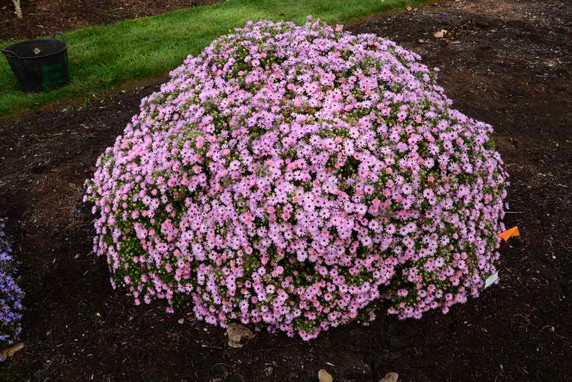
'Billowing Pink' = new selection of Aromatic Aster - very vigorous, dense, with high percentage flower coverage and very late blooming! Bubble gum pink flowers 1½" in diameter.
Healthy foliage - mildew free!
This plants needs space, and in 3 years will form strong wide clumps 26" tall and 48" wide - you have to plant for the final spacing (place 24-28" apart, or even more. Because it can easily smother it's neighbors!
Dense ground covering growth, if planted in groups or masses - it will form one uniform huge slump in time!
Valuable late blooming pollinator magnet and good substitute for garden mums!
Crushed or rubbed leaves have pleasant aroma - deer and rabbit avoid it!
Blooming Time: for six-weeks! In zone 5 from late September to mid-November.
Size: 26" tall x 48" wide clumps
USDA Zones: 4 to 8
Culture: Full sun to half shade. Average soils, soils with some drainage. Adaptable to soil types (loam, clay, sandy, chalk, acidic, alkaline, neutral).
Ideal is moderately fertile, humus rich and medium moist soil with some drainage.
Moisture Needs: average (medium), medium-moist, medium-dry. Established plants should be tolerant to drought
Origin: "In 2008, a more formal aster improvement program was initiated at the Chicago Botanic Garden using cultivars of aromatic aster (S. oblongifolium) and New England aster (S. novae-angliae) that performed well in the plant evaluation program’s trials along with other promising selections. Breeding of aromatic aster (S. oblongifolium) resulted in the cultivar ‘Cotton Candy’, which was subsequently used as the seed parent in crosses made in September 2012 with pooled pollen of hybrid origin. This cross led to the development of the cultivars ‘Billowing Pink’ and ‘Billowing Violet’." Plantsnouveau
This cultivar is pateted under PP32556.
The (wild) species of A. oblongifolius is native to Northeastern and central United States – grows on limestone glades, slopes, prairies and dry open ground. See distribution on USDA map. New name for this aster is Symphyotrichum oblongifolium.
Deer/Rabbit Resistant: yes / yes
Attracts Butterflies or Pollinators: yes / yes
Attracts Hummingbirds: possibly yes
Pot Size: square 3.5" x 4" deep perennial pot
Plant Combinations: Superior plant for public landscaping, deer resistant plantings, lower-maintenance plantings, "ground-cover" type of plantings, erosion control in sunny locations, bigger cottage gardens, butterfly or pollinator gardens, or substitute for garden mums.
Goes well with many common perennials (non-native and native), excellent with bigger grasses! The list of good companions could be endless. But we recommend choosing strong growing bigger companions and proper spacing : Amsonia, Baptisia, large cultivars of Coreopsis (Coreopsis tripteris 'Gold Standard', and similar), Eupatorium (on medium-moist soils), Hemerocallis, bearded Iris, large Nepeta, Peonia, bigger Perovskia, Pycnanthemum, Rudbeckias, Stachys byzantina 'Big Ears', Silphium, Vernonia, etc. and grasses like Andropogon, Muhlenbergia, Panicum, Pennisetum, Sporobolus, Sorghastrum, Panicum, Schizachyrium and also medium-sized shrubs.
Pictures copyright: Plants Nouveau

Aster oblongifolius 'Billowing Pink' - AROMATIC ASTER 'BILLOWING PINK'
$11.99
Details
'Billowing Pink' = new selection of Aromatic Aster - very vigorous, dense, with high percentage flower coverage and very late blooming! Bubble gum pink flowers 1½" in diameter.
Healthy foliage - mildew free!
This plants needs space, and in 3 years will form strong wide clumps 26" tall and 48" wide - you have to plant for the final spacing (place 24-28" apart, or even more. Because it can easily smother it's neighbors!
Dense ground covering growth, if planted in groups or masses - it will form one uniform huge slump in time!
Valuable late blooming pollinator magnet and good substitute for garden mums!
Crushed or rubbed leaves have pleasant aroma - deer and rabbit avoid it!
Blooming Time: for six-weeks! In zone 5 from late September to mid-November.
Size: 26" tall x 48" wide clumps
USDA Zones: 4 to 8
Culture: Full sun to half shade. Average soils, soils with some drainage. Adaptable to soil types (loam, clay, sandy, chalk, acidic, alkaline, neutral).
Ideal is moderately fertile, humus rich and medium moist soil with some drainage.
Moisture Needs: average (medium), medium-moist, medium-dry. Established plants should be tolerant to drought
Origin: "In 2008, a more formal aster improvement program was initiated at the Chicago Botanic Garden using cultivars of aromatic aster (S. oblongifolium) and New England aster (S. novae-angliae) that performed well in the plant evaluation program’s trials along with other promising selections. Breeding of aromatic aster (S. oblongifolium) resulted in the cultivar ‘Cotton Candy’, which was subsequently used as the seed parent in crosses made in September 2012 with pooled pollen of hybrid origin. This cross led to the development of the cultivars ‘Billowing Pink’ and ‘Billowing Violet’." Plantsnouveau
This cultivar is pateted under PP32556.
The (wild) species of A. oblongifolius is native to Northeastern and central United States – grows on limestone glades, slopes, prairies and dry open ground. See distribution on USDA map. New name for this aster is Symphyotrichum oblongifolium.
Deer/Rabbit Resistant: yes / yes
Attracts Butterflies or Pollinators: yes / yes
Attracts Hummingbirds: possibly yes
Pot Size: square 3.5" x 4" deep perennial pot
Plant Combinations: Superior plant for public landscaping, deer resistant plantings, lower-maintenance plantings, "ground-cover" type of plantings, erosion control in sunny locations, bigger cottage gardens, butterfly or pollinator gardens, or substitute for garden mums.
Goes well with many common perennials (non-native and native), excellent with bigger grasses! The list of good companions could be endless. But we recommend choosing strong growing bigger companions and proper spacing : Amsonia, Baptisia, large cultivars of Coreopsis (Coreopsis tripteris 'Gold Standard', and similar), Eupatorium (on medium-moist soils), Hemerocallis, bearded Iris, large Nepeta, Peonia, bigger Perovskia, Pycnanthemum, Rudbeckias, Stachys byzantina 'Big Ears', Silphium, Vernonia, etc. and grasses like Andropogon, Muhlenbergia, Panicum, Pennisetum, Sporobolus, Sorghastrum, Panicum, Schizachyrium and also medium-sized shrubs.
Pictures copyright: Plants Nouveau


Sale 20%

Customer Reviews

Shipped With Care
Secure packaging for safe delivery
Nursery Grown Plants
Healthy, well-rooted perennials
Curated Plant Selection
Reliable performers for real gardens