

Sold out

Zoom the image with the mouse
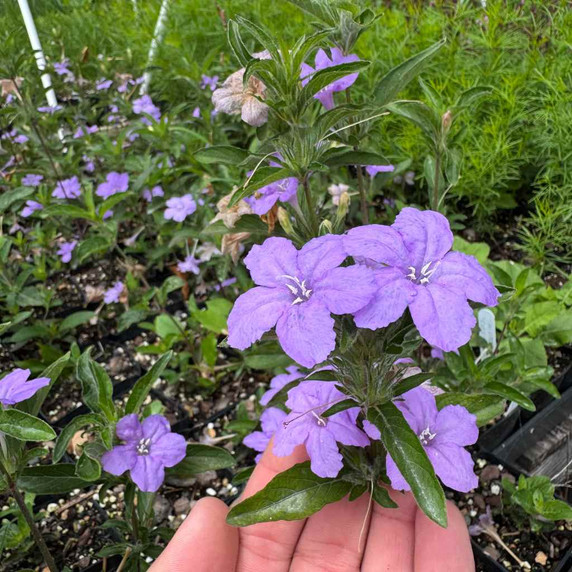
Ruellia caroliniensis - CAROLINA WILD PETUNIA
Product Code:
RUE-CAR-1
Shipping:
Calculated at Checkout
$8.99
Showy long-lived native clumping perennial.
Purple-blue flowers are slightly smaller than more common R. humilis (it also doesn't seed aggressively as R. humilis- Wild Petunia). Leaves more elongated and a bit glossy.
Each flower lasts only 1 day, but they keep opening and the bloom period is very long.
Excellent plant for drier half shade or dappled shade.
Blooming Time: June - August
Size: size depends on the growing conditions. The average size in average conditions is about 1-1.5' tall ad 1.5-2' wide. But in rich soils in partial shade, with enough moisture can reach 3' of height and 2.5'-3' in width.
USDA Zones: 5-6 to 9/10
Culture: partial sun to half shade, dappled lighter shade, preferably somewhat drained soils with average moisture or dry
Moisture Needs: dry to medium-dry, average. Can withstand full sun only with constant moisture (so it is really the drier woodland edge plant with somelittle shade).
Origin: native to states from Texas diagonally to northeastern USA, see the BONAP distribution map. Naturally occurs in sandy, upland, open woods, pinelands on mesic to dry soils (sandy, rocky, gritty, drained)
Deer/Rabbit Resistant: yes, unpalatable
Attracts Butterflies or Pollinators: yes / yes, offers nectar and pollen for bees, butterflies, wasps, the foliage supports the larval stage of the Common Buckeye butterfly.
Attracts Hummingbirds: yes
Pot Size: square 3.5" x 4" deep perennial pot
Plant combinations: Woodland edge plant, drier partially shaded areas, close to the tree root zone, edging plant, and is rock gardens, savanna plantings, pollinator and wild gardens. Good companions are primarily plants with similar needs like Aconitum, Amsonia (with wider leaves - those tolerate more shade), Aster divaricatus, Dicentra, Epimedium, Heuchera, Helleborus, Gillenia, Iris (I. tectorum, I. verna, I. cristata and asian counterparts), Liatris microcephalla, shade Peonias, Phlox divaricata, Phlox bifida, Phlox stolonifera, Polygonatum, Rudbeckia fulgida 'Goldsturm', Saruma henryi, Scutellaria, Solidago (ceasia, flexicaulis, sphaecelata), Spigelia, Waldsteinia, native ferns, grasses like Hakonechloa, and Carex (sedges) - Carex albicans, Carex pennsylvanica, Carex woodii and many more. Goes well with native spring ephemerals.
Ruellia caroliniensis - CAROLINA WILD PETUNIA
$8.99
Details
Showy long-lived native clumping perennial.
Purple-blue flowers are slightly smaller than more common R. humilis (it also doesn't seed aggressively as R. humilis- Wild Petunia). Leaves more elongated and a bit glossy.
Each flower lasts only 1 day, but they keep opening and the bloom period is very long.
Excellent plant for drier half shade or dappled shade.
Blooming Time: June - August
Size: size depends on the growing conditions. The average size in average conditions is about 1-1.5' tall ad 1.5-2' wide. But in rich soils in partial shade, with enough moisture can reach 3' of height and 2.5'-3' in width.
USDA Zones: 5-6 to 9/10
Culture: partial sun to half shade, dappled lighter shade, preferably somewhat drained soils with average moisture or dry
Moisture Needs: dry to medium-dry, average. Can withstand full sun only with constant moisture (so it is really the drier woodland edge plant with somelittle shade).
Origin: native to states from Texas diagonally to northeastern USA, see the BONAP distribution map. Naturally occurs in sandy, upland, open woods, pinelands on mesic to dry soils (sandy, rocky, gritty, drained)
Deer/Rabbit Resistant: yes, unpalatable
Attracts Butterflies or Pollinators: yes / yes, offers nectar and pollen for bees, butterflies, wasps, the foliage supports the larval stage of the Common Buckeye butterfly.
Attracts Hummingbirds: yes
Pot Size: square 3.5" x 4" deep perennial pot
Plant combinations: Woodland edge plant, drier partially shaded areas, close to the tree root zone, edging plant, and is rock gardens, savanna plantings, pollinator and wild gardens. Good companions are primarily plants with similar needs like Aconitum, Amsonia (with wider leaves - those tolerate more shade), Aster divaricatus, Dicentra, Epimedium, Heuchera, Helleborus, Gillenia, Iris (I. tectorum, I. verna, I. cristata and asian counterparts), Liatris microcephalla, shade Peonias, Phlox divaricata, Phlox bifida, Phlox stolonifera, Polygonatum, Rudbeckia fulgida 'Goldsturm', Saruma henryi, Scutellaria, Solidago (ceasia, flexicaulis, sphaecelata), Spigelia, Waldsteinia, native ferns, grasses like Hakonechloa, and Carex (sedges) - Carex albicans, Carex pennsylvanica, Carex woodii and many more. Goes well with native spring ephemerals.



Customer Reviews

Shipped With Care
Secure packaging for safe delivery
Nursery Grown Plants
Healthy, well-rooted perennials
Curated Plant Selection
Reliable performers for real gardens