


Zoom the image with the mouse
Helleborus niger 'Snowbells' - BLACK HELLEBORE 'SNOWBELLS' (LENTEN ROSE)
Product Code:
HEL-NIG-SNO
Shipping:
Calculated at Checkout
$15.99
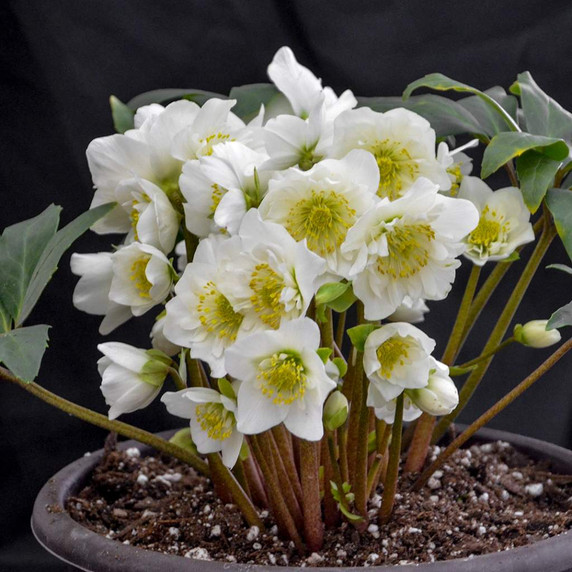
Earlier blooming and smaller cultivar with 2½-3" pure white flowers. 5 petals and smaller petaloids make the flower look semi-double. Blooms before most of the hybrids, sometimes start blooming in December.
Vigorous, trouble free, early bloomer, great combination with hosta.
Tolerant to black walnuts, long-lived, dry shade tolerant, tough and is a somewhat ground-covering perennial.
Blooming Time: January/February to March/April (depending on your zone). Flowers fade to greenish.
Size: 10-12" tall and 12-14"wide, in time forms wider clumps
USDA Zones: 4 to 9
Culture: Half shade, dappled sun, dappled shade to full shade, virtually any soil that is not waterlogged
Moisture Needs: medium-moist to medium-dry
Origin: H. niger is native to the mountains of central and southern Europe (the Alps and Apennines, from northern Italy, southern Germany, Austria to Slovenia, Croatia, Bosnia).
Black Walnut Tolerant: yes
Deer/Rabbit Resistant: yes / yes
Attracts Butterflies or Pollinators: honey bees, possibly some native bees and flies
Attracts Hummingbirds: no
Pot Size: square 3.5" x 4" deep pot
Plant combinations: Best in half shade, dappled shade, woodland edge gardens, shade gardens, under shrubs and trees. Meets in bloom and goes well with many spring bulbs and spring ephmerals. Looks good with fine structures like grassy leaves - Carex (sedges), Hakonechloa, narrow-leaved Hosta, Iris cristata (and the Asian counterparts) or Tradescantia and also fine leaves of ferns!
Good companions can be also shorter cultivars of Amsonia, smaller Alchemilla, Anemone hupehensis (japonica), Aquilegia, Asarum, woodland Aster (Aster divaricatus etc.), Brunnera, Chelone lyonii, Dicentra, Disporum, Epimedium, Gallium odoratum, most of common hardy Geraniums, Helleborus, Heuchera and Heucherella, Geum, Lysimachia, Mellittis, Mukdenia, Nepeta subsessillis, Penstemon digitalis and calycosus (and hybrids), Phlox (x carolina and interspecific hybrids, Phlox divaricata, Phlox stolonifera, Phlox bifida), Podophyllum, Polemonium, Polygonatum, Primula, Pulmonaria, Sedum ternatum, Stachys officinalis hybrids, Stylophorum, Tiarella, Tricyrtis, Uvularia, Viola or Waldsteinia.
Picture copyright : Walters Gardens
Helleborus niger 'Snowbells' - BLACK HELLEBORE 'SNOWBELLS' (LENTEN ROSE)
$15.99
Details
Earlier blooming and smaller cultivar with 2½-3" pure white flowers. 5 petals and smaller petaloids make the flower look semi-double. Blooms before most of the hybrids, sometimes start blooming in December.
Vigorous, trouble free, early bloomer, great combination with hosta.
Tolerant to black walnuts, long-lived, dry shade tolerant, tough and is a somewhat ground-covering perennial.
Blooming Time: January/February to March/April (depending on your zone). Flowers fade to greenish.
Size: 10-12" tall and 12-14"wide, in time forms wider clumps
USDA Zones: 4 to 9
Culture: Half shade, dappled sun, dappled shade to full shade, virtually any soil that is not waterlogged
Moisture Needs: medium-moist to medium-dry
Origin: H. niger is native to the mountains of central and southern Europe (the Alps and Apennines, from northern Italy, southern Germany, Austria to Slovenia, Croatia, Bosnia).
Black Walnut Tolerant: yes
Deer/Rabbit Resistant: yes / yes
Attracts Butterflies or Pollinators: honey bees, possibly some native bees and flies
Attracts Hummingbirds: no
Pot Size: square 3.5" x 4" deep pot
Plant combinations: Best in half shade, dappled shade, woodland edge gardens, shade gardens, under shrubs and trees. Meets in bloom and goes well with many spring bulbs and spring ephmerals. Looks good with fine structures like grassy leaves - Carex (sedges), Hakonechloa, narrow-leaved Hosta, Iris cristata (and the Asian counterparts) or Tradescantia and also fine leaves of ferns!
Good companions can be also shorter cultivars of Amsonia, smaller Alchemilla, Anemone hupehensis (japonica), Aquilegia, Asarum, woodland Aster (Aster divaricatus etc.), Brunnera, Chelone lyonii, Dicentra, Disporum, Epimedium, Gallium odoratum, most of common hardy Geraniums, Helleborus, Heuchera and Heucherella, Geum, Lysimachia, Mellittis, Mukdenia, Nepeta subsessillis, Penstemon digitalis and calycosus (and hybrids), Phlox (x carolina and interspecific hybrids, Phlox divaricata, Phlox stolonifera, Phlox bifida), Podophyllum, Polemonium, Polygonatum, Primula, Pulmonaria, Sedum ternatum, Stachys officinalis hybrids, Stylophorum, Tiarella, Tricyrtis, Uvularia, Viola or Waldsteinia.
Picture copyright : Walters Gardens
Sale 25%

Customer Reviews

Shipped With Care
Secure packaging for safe delivery
Nursery Grown Plants
Healthy, well-rooted perennials
Curated Plant Selection
Reliable performers for real gardens