


Anemarrhena asphodeloides - ZHI MU
Plant well known in Traditional Chinese Medicine. Less known in garden culture.
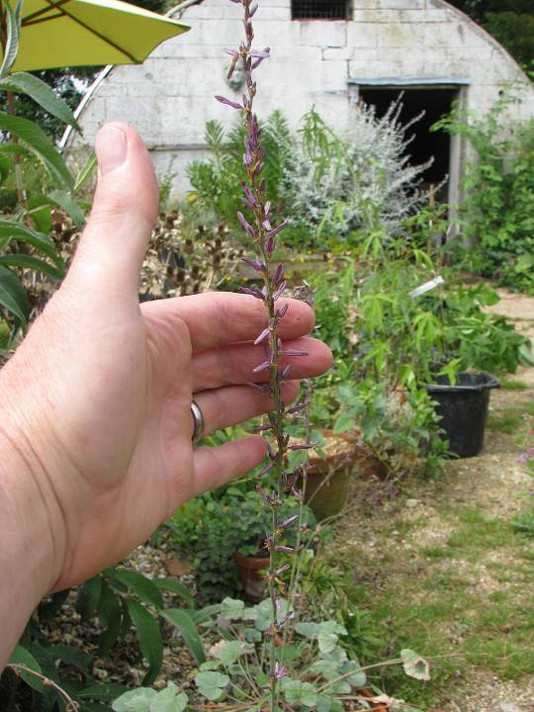
Somewhat grassy gray-green lily-like leaves, long flowering spikes with tiny purplish flowers.
Thick root is harvested as the medicinal plant and has variety of use (from congestive fever, high fever, chronic bronchitis, excessive sweating, dry throat, cough, dizziness, lumbago and pneumonia and more).
This plant moved from several families (Lily, Asparagus and Agave Family) and ended up in it's own Anemarrhenaceae family as the oly species.
Blooming Time: late summer (August/September)
Size: clumps of leaves about 14-18" tall and 12-16" wide, flowering stems 30-36" tall
USDA Zones: 5/6 to 9
Culture: full sun, partial sun, average soil amended with some organic matter and sand, average soils, drained soils (rocky, sandy, gritty, shallow, drier soils). Drought and heat tolerant.
Moisture Needs: dry, medium-dry, medium
Origin: Native to East Asia - primarily in China (Northern, Northeastern, Western China) and Mongolia. Introduced to Taiwan, Japan and Korea. In natural habitats grows in sunny, sandy hillsides, rocky slopes, and grasslands (in variable elevations from the sea level to 4900 ft).
Deer/Rabbit Resistant: yes / yes
Attracts Butterflies or Pollinators: moths.
Attracts Hummingbirds: yes
Pot Size: 3.5" x 4" perennial pot (1.22 pt/580 ml)
Picture copyright: peganum, Wikimedia Commons
Plant combinations: The best for sunny garden, herb gardens, collector's garden.
Good perennial company could be smaller - medium sized native wildflowers and their cultivars: Amorpha nana, Asclepias tuberosa, Asclepias verticillata, Aster laevis, Aster ericoides, smaller Coreopsis, Cunila origanoides, smaller Echinacea purpurea hybrids, Echinacea tennesseensis, Echinacea pallida or angustifolia, Echinacea paradoxa, Euphorbia corollata, Penstemon, Rudbeckia missouriensis and hybrids, Sisyrinchium angustifolium and grasses like Boutelloua gracilis, Eragrostis elliotii, Koeleria macrantha or cristata, Muhlenbergia capillaris, Sporobolus heterolepis, and Schizachyrium scoparium.
From non-native perennials, choose Allium 'Millenium', smaller Nepeta, Calamintha nepeta, Iris x germanica, Iris tectorum, Lavandula officinalis, Lavandula x intermedia, Perovskia, Stachys byzantina, Stachys macrantha and and other drought tolerant perennials.

Anemarrhena asphodeloides - ZHI MU
.jpg)
Plant well known in Traditional Chinese Medicine. Less known in garden culture.
Somewhat grassy gray-green lily-like leaves, long flowering spikes with tiny purplish flowers.
Thick root is harvested as the medicinal plant and has variety of use (from congestive fever, high fever, chronic bronchitis, excessive sweating, dry throat, cough, dizziness, lumbago and pneumonia and more).
This plant moved from several families (Lily, Asparagus and Agave Family) and ended up in it's own Anemarrhenaceae family as the oly species.
Blooming Time: late summer (August/September)
Size: clumps of leaves about 14-18" tall and 12-16" wide, flowering stems 30-36" tall
USDA Zones: 5/6 to 9
Culture: full sun, partial sun, average soil amended with some organic matter and sand, average soils, drained soils (rocky, sandy, gritty, shallow, drier soils). Drought and heat tolerant.
Moisture Needs: dry, medium-dry, medium
Origin: Native to East Asia - primarily in China (Northern, Northeastern, Western China) and Mongolia. Introduced to Taiwan, Japan and Korea. In natural habitats grows in sunny, sandy hillsides, rocky slopes, and grasslands (in variable elevations from the sea level to 4900 ft).
Deer/Rabbit Resistant: yes / yes
Attracts Butterflies or Pollinators: moths.
Attracts Hummingbirds: yes
Pot Size: 3.5" x 4" perennial pot (1.22 pt/580 ml)
Picture copyright: peganum, Wikimedia Commons
Plant combinations: The best for sunny garden, herb gardens, collector's garden.
Good perennial company could be smaller - medium sized native wildflowers and their cultivars: Amorpha nana, Asclepias tuberosa, Asclepias verticillata, Aster laevis, Aster ericoides, smaller Coreopsis, Cunila origanoides, smaller Echinacea purpurea hybrids, Echinacea tennesseensis, Echinacea pallida or angustifolia, Echinacea paradoxa, Euphorbia corollata, Penstemon, Rudbeckia missouriensis and hybrids, Sisyrinchium angustifolium and grasses like Boutelloua gracilis, Eragrostis elliotii, Koeleria macrantha or cristata, Muhlenbergia capillaris, Sporobolus heterolepis, and Schizachyrium scoparium.
From non-native perennials, choose Allium 'Millenium', smaller Nepeta, Calamintha nepeta, Iris x germanica, Iris tectorum, Lavandula officinalis, Lavandula x intermedia, Perovskia, Stachys byzantina, Stachys macrantha and and other drought tolerant perennials.
Customer Reviews

Shipped With Care
Secure packaging for safe delivery
Nursery Grown Plants
Healthy, well-rooted perennials
Curated Plant Selection
Reliable performers for real gardens