

Carex x 'Moon Falls'™ - SEDGE 'MOON FALLS'
Very wide clumping sedge with variegated leaves (cream-yellow stripe in the middle of the leaf).
More tolerant to sun and heat than some older cultivars.
Versatile, tough and adaptable problem solver.
New addition to excellent 'Feather Falls', but with reversed and more yellow stripes.
Blooming Time: April/May
Size: 12" high x 24" and spreading to 46" wide clumps in 5 years, slowly spreading
USDA Zones: 5 to 8
Culture: very adaptable - partial sun, half shade, light shade, average soils, clay, adaptable, but prefers neutral to slightly acidic soils
Moisture Needs: average (medium), medium-moist, medium-dry (to seasonally dry)
Origin: garden origin, cross of three Asian species, introduced by Bart Noordhuis and Elisabeth Bisschop (Exceptio Plants, Boijl, Netherlands). Plant is patented under PP35022.
Black walnut tolerance: yes
Deer/Rabbit Resistant: yes / yes
Attracts Butterflies or Pollinators: no
Attracts Hummingbirds: no
Pot Size: square 3.5" x 4" deep pot
Pictures copyright: Emerald Coast Growers
Plant combinations: In masses, bigger groups, or as specimen, large containers at patios, woodland edge gardens, areas with difficult to identify sun/shade conditions, larger rain gardens. Lawn substitute in difficult spots. Goes well with majority of native and non-native perennials. Good companions can be Amsonia, Actaea (Cimicifuga), Aruncus, Astilbe, Brunnera, ferns, Heuchera, Hemerocallis, Hosta, Helleborus, Iris cristata, I. tectorum, Iris sibirica, Polygonatum, spring bulbs, other Carex, Hakonechloa and many others.

Carex x 'Moon Falls'™ - SEDGE 'MOON FALLS'
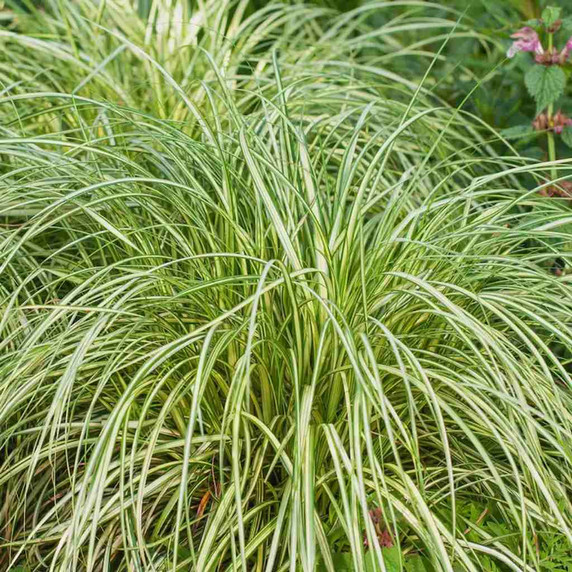
Very wide clumping sedge with variegated leaves (cream-yellow stripe in the middle of the leaf).
More tolerant to sun and heat than some older cultivars.
Versatile, tough and adaptable problem solver.
New addition to excellent 'Feather Falls', but with reversed and more yellow stripes.
Blooming Time: April/May
Size: 12" high x 24" and spreading to 46" wide clumps in 5 years, slowly spreading
USDA Zones: 5 to 8
Culture: very adaptable - partial sun, half shade, light shade, average soils, clay, adaptable, but prefers neutral to slightly acidic soils
Moisture Needs: average (medium), medium-moist, medium-dry (to seasonally dry)
Origin: garden origin, cross of three Asian species, introduced by Bart Noordhuis and Elisabeth Bisschop (Exceptio Plants, Boijl, Netherlands). Plant is patented under PP35022.
Black walnut tolerance: yes
Deer/Rabbit Resistant: yes / yes
Attracts Butterflies or Pollinators: no
Attracts Hummingbirds: no
Pot Size: square 3.5" x 4" deep pot
Pictures copyright: Emerald Coast Growers
Plant combinations: In masses, bigger groups, or as specimen, large containers at patios, woodland edge gardens, areas with difficult to identify sun/shade conditions, larger rain gardens. Lawn substitute in difficult spots. Goes well with majority of native and non-native perennials. Good companions can be Amsonia, Actaea (Cimicifuga), Aruncus, Astilbe, Brunnera, ferns, Heuchera, Hemerocallis, Hosta, Helleborus, Iris cristata, I. tectorum, Iris sibirica, Polygonatum, spring bulbs, other Carex, Hakonechloa and many others.