

Sold out


Southeastern native shrub, endangered in natural habitats.
Great wildlife support - attracts various bees, butterflies and hummingbirds.
Long season flowering. Pale yellow to greenish tubular flowers in clusters.
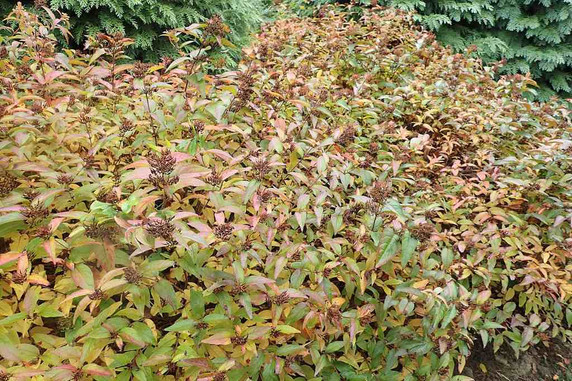
Good fall yellow-red color.
Blooming Time: June/July to August
Size: usually 4' tall x 5' wide mounding shrubs. In ideal conditions up to 6' tall x 8' wide. Slowly spreads by underground rhizomes and forms small colonies
USDA zones: 5 to 7/8
Culture: full sun, half shade. Average soil with average moisture, drained soil (with some gritty or rocky component), tolerates clay. Adaptable to various soils and light conditions.
Moisture Needs: medium (to medium-dry and medium-moist).Tolerant to heat and humidity
Origin: primarily in Appalachian area, AL, GA, NC, TN. Can be found in bluffs, cliffs, banks, moist woods, on slopes.
Deer/rabbit resistant: yes/yes
Attracts Butterflies or Pollinators: native bees, and less butterflies
Attracts Hummingbirds: yes
Pot size: square 3.5 " x 4" deep perennial pot
Plant combinations: For cottage gardens, pollinator gardens, hummingbird gardens, slopes, erosion control, naturalization in the woodland edge gardens. Good companions can be many medium-sized or bigger common perennials. In sunny location it can be Amsonia, Asters, Baptisia, taller hardy Geraniums, Irises, larger Nepeta, Paeonia, Rudbeckia, larger Salvia, tall Sedum, grasses like Calamagrostis or Panicum.
In half-shade, dappled sun/shade woodland edge/ woodland perennials - Aquilegia, Anemone x hupehensis, Chelone, Chrysogonum, Dicentra, Gillenia, Geum, Helleborus, Heuchera, Hosta, Polemonium, Polygonatum, Polygonum, Tradescantia, Tricyrtis, Spigellia, or sedges - Carex or Hakonechloa.
Or combine with medium-sized shrubs.
Picture copyright: Krzysztof Ziarnek, Commons Wikimedia
Southeastern native shrub, endangered in natural habitats.
Great wildlife support - attracts various bees, butterflies and hummingbirds.
Long season flowering. Pale yellow to greenish tubular flowers in clusters.
Good fall yellow-red color.
Blooming Time: June/July to August
Size: usually 4' tall x 5' wide mounding shrubs. In ideal conditions up to 6' tall x 8' wide. Slowly spreads by underground rhizomes and forms small colonies
USDA zones: 5 to 7/8
Culture: full sun, half shade. Average soil with average moisture, drained soil (with some gritty or rocky component), tolerates clay. Adaptable to various soils and light conditions.
Moisture Needs: medium (to medium-dry and medium-moist).Tolerant to heat and humidity
Origin: primarily in Appalachian area, AL, GA, NC, TN. Can be found in bluffs, cliffs, banks, moist woods, on slopes.
Deer/rabbit resistant: yes/yes
Attracts Butterflies or Pollinators: native bees, and less butterflies
Attracts Hummingbirds: yes
Pot size: square 3.5 " x 4" deep perennial pot
Plant combinations: For cottage gardens, pollinator gardens, hummingbird gardens, slopes, erosion control, naturalization in the woodland edge gardens. Good companions can be many medium-sized or bigger common perennials. In sunny location it can be Amsonia, Asters, Baptisia, taller hardy Geraniums, Irises, larger Nepeta, Paeonia, Rudbeckia, larger Salvia, tall Sedum, grasses like Calamagrostis or Panicum.
In half-shade, dappled sun/shade woodland edge/ woodland perennials - Aquilegia, Anemone x hupehensis, Chelone, Chrysogonum, Dicentra, Gillenia, Geum, Helleborus, Heuchera, Hosta, Polemonium, Polygonatum, Polygonum, Tradescantia, Tricyrtis, Spigellia, or sedges - Carex or Hakonechloa.
Or combine with medium-sized shrubs.
Picture copyright: Krzysztof Ziarnek, Commons Wikimedia


