Sold out

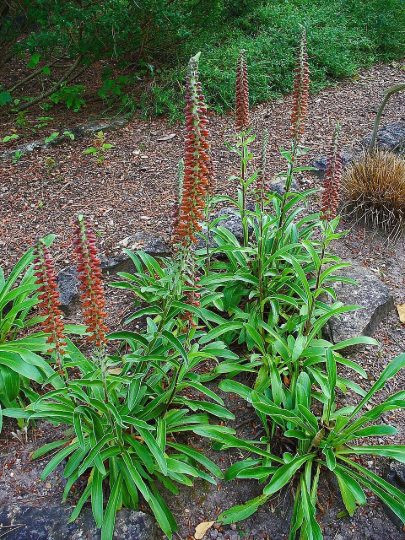
Vertical and narrow plant, with evergreen basal rosettes and subtle spikes of tiny brown-red flowers.
Good cut flower. Shorter-lived perennial, on a good site persist by self-seeding (or collect some seeds and sprinkle, where desired).
Toxic to humans, dogs, cats, and horses if ingested.
Award of Garden Merit by RHS (Royal Horticultural Society in Britain).
Blooming Time: June-July
Size: 1.5-2' tall x 0.5-0.75' wide
USDA Zones: 4 to 8
Culture: partial sun to part shade, (tolerates light shade, if the soils are drained). Average soil, drained soil (with some gritty, rocky component of sand).
Moisture Needs: average (medium), medium-dry
Origin: endemic to Northern and Central Spain
Deer/Rabbit Resistant: yes / yes
Attracts Butterflies or Pollinators: yes / yes
Attracts Hummingbirds: no
Pot Size: square 3.5" x 4" deep pot
Picture Copyright: H. Zell, Commons Wikipedia
Plant combinations: best in small group or scattered as a vertical accent in smaller beds. Flower beds, xeriscape, rock gardens, best on somewhat drained or drained soils. Goes well with many perennials, but for it's delicate look better combined with smaller to medium-sized ones like : Antennaria, Agapanthus, Aclepis tuberosa, Aster (A. ericoides, A. laevis, A. oolentangiensis), Amorpha canescens, Anaphallis margaritacea, short Baptisia, alamintha, Callirhoe, Campanula, Coreopsis, Dalea, shorter Echinacea hybrids, Eryngium, shorter Geranium, Lavandula, Liatris, Oenothera, smaller Perovskia, shorter Rudbeckia, Salvia, Veronica, and grasses like Boutelloua, Koeleria, Muhlenbergia, short Panicum, Schizachyrium or Sporobolus.
Vertical and narrow plant, with evergreen basal rosettes and subtle spikes of tiny brown-red flowers.
Good cut flower. Shorter-lived perennial, on a good site persist by self-seeding (or collect some seeds and sprinkle, where desired).
Toxic to humans, dogs, cats, and horses if ingested.
Award of Garden Merit by RHS (Royal Horticultural Society in Britain).
Blooming Time: June-July
Size: 1.5-2' tall x 0.5-0.75' wide
USDA Zones: 4 to 8
Culture: partial sun to part shade, (tolerates light shade, if the soils are drained). Average soil, drained soil (with some gritty, rocky component of sand).
Moisture Needs: average (medium), medium-dry
Origin: endemic to Northern and Central Spain
Deer/Rabbit Resistant: yes / yes
Attracts Butterflies or Pollinators: yes / yes
Attracts Hummingbirds: no
Pot Size: square 3.5" x 4" deep pot
Picture Copyright: H. Zell, Commons Wikipedia
Plant combinations: best in small group or scattered as a vertical accent in smaller beds. Flower beds, xeriscape, rock gardens, best on somewhat drained or drained soils. Goes well with many perennials, but for it's delicate look better combined with smaller to medium-sized ones like : Antennaria, Agapanthus, Aclepis tuberosa, Aster (A. ericoides, A. laevis, A. oolentangiensis), Amorpha canescens, Anaphallis margaritacea, short Baptisia, alamintha, Callirhoe, Campanula, Coreopsis, Dalea, shorter Echinacea hybrids, Eryngium, shorter Geranium, Lavandula, Liatris, Oenothera, smaller Perovskia, shorter Rudbeckia, Salvia, Veronica, and grasses like Boutelloua, Koeleria, Muhlenbergia, short Panicum, Schizachyrium or Sporobolus.