Sold out


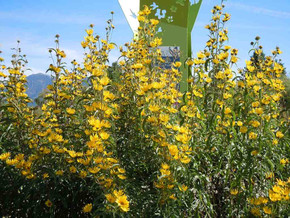
Native perennial sunflower with high ecological value.
Ideal for half shade garden, woodland edge and for naturalization.
Yellow flowers of 3" in diameter.
Blooming Time: from mid summer to fall (about July/August to September/October)
Size: 5' tall x 3' wide, spread by rhizomes to small colonies
USDA Zones: 4 to 9
Culture: half sun, half shade, full shade, adaptable to most soils that stay medium-moist, including heavier soil or clay. Established plants will tolerate seasonal droughts, but may be stressed some. Fertilizing can lead to thinner stems = flopping (especially with more shade).
Moisture Needs: medium, medium-moist, moist to wet
Origin: native to eastern half of USA, see BONAP distribution map. Often found in moist to mesic conditions in wet open woods, woodland clearings, partially shaded banks of rivers or streams, savannas, meadows and thickets.
Deer/Rabbit Resistant: both can nibble on young shoots
Attracts Butterflies or Pollinators: yes / yes. Flowers offer nectar and pollen and primarily attract bees (honeybees, bumblebees, little carpenter bees, long-horned bees, cuckoo bees, leaf-cutting bees, Halictine bees, incl. green metallic bees). Other visitors can be Syrphid flies, bee flies, and butterflies.
Many kinds of insects also feed destructively on the plants (weevils, larvae of long-horned beetles, leaf beetles, larvae of leaf-mining flies, larvae of gall flies, plant bugs, aphids, leafhoppers, treehoppers, grasshoppers, larvae of tiger moths, larvae of owlet moths larvae of Tortrix moths, and larvae of such brush-footed butterflies as the Gorgone Checkerspot, Silvery Checkerspot, and Painted Lady. The seeds attract many songbirds, upland gamebirds, and crows. Mammals feed on the plants (voles, groundhog, deer, livestock).
Attracts Hummingbirds: no
Pot Size: square 3.5" x 4" deep perennial pot
Plant Combinations: Best for partially shaded woodland edges, sun-shade transition parts of gardens, under the canopy of big trees, in pollinator gardens, wildlife gardens.
Good companions ca be Aralia, Aruncus, Aquilegia, Amsonia, Baptisia, Chelone, Coreopsis palustris, Echinacea purpurea, Eupatorium (Joe Pye Weed), Hemerocallis (daylily), Hibiscus moscheutos hybrids (in half shade), large Hosta, Iris (in half shade - especially those that love some moisture like I. virginica, I. louisiana, I. pseudata, I. sibirica etc), Penstemon (calycosus/digitalis and hybrids), Persicaria, Phlox paniculata and hybrids, Polemonium, Physostegia, Rudbeckia fulgida, Rudbeckia laciniata, Sanguisorba (half shade), Vernonia, or larger Carex and ferns.
Picture Copyright: Bibliothèque de l'Université Laval, Commons Wikimedia
Native perennial sunflower with high ecological value.
Ideal for half shade garden, woodland edge and for naturalization.
Yellow flowers of 3" in diameter.
Blooming Time: from mid summer to fall (about July/August to September/October)
Size: 5' tall x 3' wide, spread by rhizomes to small colonies
USDA Zones: 4 to 9
Culture: half sun, half shade, full shade, adaptable to most soils that stay medium-moist, including heavier soil or clay. Established plants will tolerate seasonal droughts, but may be stressed some. Fertilizing can lead to thinner stems = flopping (especially with more shade).
Moisture Needs: medium, medium-moist, moist to wet
Origin: native to eastern half of USA, see BONAP distribution map. Often found in moist to mesic conditions in wet open woods, woodland clearings, partially shaded banks of rivers or streams, savannas, meadows and thickets.
Deer/Rabbit Resistant: both can nibble on young shoots
Attracts Butterflies or Pollinators: yes / yes. Flowers offer nectar and pollen and primarily attract bees (honeybees, bumblebees, little carpenter bees, long-horned bees, cuckoo bees, leaf-cutting bees, Halictine bees, incl. green metallic bees). Other visitors can be Syrphid flies, bee flies, and butterflies.
Many kinds of insects also feed destructively on the plants (weevils, larvae of long-horned beetles, leaf beetles, larvae of leaf-mining flies, larvae of gall flies, plant bugs, aphids, leafhoppers, treehoppers, grasshoppers, larvae of tiger moths, larvae of owlet moths larvae of Tortrix moths, and larvae of such brush-footed butterflies as the Gorgone Checkerspot, Silvery Checkerspot, and Painted Lady. The seeds attract many songbirds, upland gamebirds, and crows. Mammals feed on the plants (voles, groundhog, deer, livestock).
Attracts Hummingbirds: no
Pot Size: square 3.5" x 4" deep perennial pot
Plant Combinations: Best for partially shaded woodland edges, sun-shade transition parts of gardens, under the canopy of big trees, in pollinator gardens, wildlife gardens.
Good companions ca be Aralia, Aruncus, Aquilegia, Amsonia, Baptisia, Chelone, Coreopsis palustris, Echinacea purpurea, Eupatorium (Joe Pye Weed), Hemerocallis (daylily), Hibiscus moscheutos hybrids (in half shade), large Hosta, Iris (in half shade - especially those that love some moisture like I. virginica, I. louisiana, I. pseudata, I. sibirica etc), Penstemon (calycosus/digitalis and hybrids), Persicaria, Phlox paniculata and hybrids, Polemonium, Physostegia, Rudbeckia fulgida, Rudbeckia laciniata, Sanguisorba (half shade), Vernonia, or larger Carex and ferns.
Picture Copyright: Bibliothèque de l'Université Laval, Commons Wikimedia