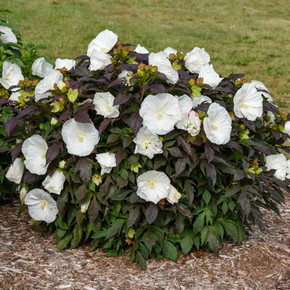
Hibiscus 'Watermelon Ruffles' - ROSEMALLOW 'WATERMELON RUFFLES'
Rose Mallow 'Watermelon Ruffles' offers large 7" pink magenta ruffled flowers and excellent growing habit = with blooms from the top to the bottom part.
The end of each petal is so puckered they appear notched
Long blooming period.
Attracts hummingbirds and some bees.
Blooming Time: July to September, blooms continuously
Size: 4.5' tall and 4.5' wide
USDA Zones: 4 to 9
Culture: full sun to half shade, very adaptable to a variety of soils, but the best results (size, blooming) are in moderately fertile to loamy soil. Adapts to most pH, but neutral to slightly acidic are the best.
Moisture Needs: average (medium) to medium-moist (soil wit average moisture to boggy conditions)
Origin: selected by the Walters Gardens. Hybrid of several native species of Hibiscus. Plant Patent applied.
Deer/Rabbit Resistant: yes / yes
Attracts Butterflies or Pollinators: not known / yes - bee friendly
Attracts Hummingbirds: yes
Pot Size: square 3.5" x' 4" deep perennialpot
Plant combinations: Flower beds, exotic gardens, coastal gardens, rain gardens, bog gardens. This plant has bold structure, so it's the best to use it as an accent plant and combine it with more delicate looking plants with smaller leaves.
It can be also planted as a solitaire plant or mixed with true woody shrubs. Due to it's adaptability ("elasticity") can be combined with majority of the common plants - those that grow well in average sunny bed and also with plants that require more moisture.
To point out the best visual companions, lets mention at least - Asclepias incarnata, Helianthus angustifolius and hybrids, Iris (I. sibirica, I. x lousiana, I. versicolor, I. ensata, I. pseudata, I. virginica), Lobelia, Lysimachia, Mimulus, Persicaria amplexicaulis, Phlox paniculata (with smaller flowers), Phlox maculata, Physostegia, Sanquisorba, Thalictrum, Verbena bonariensis, Veronicastrum and grasses and sedges - Carex, Andropogon gerardii and cultivars, Calamagrostis, Chasmantium, Deschmapsia, Panicum, Pennisetum and Miscanthus (where these two are not invasive).
Can be also used with mounding plants like Amsonia, Baptisia, Chelone, Hemerocallis (better with smaller flowers) or with lower growing or groundcovering plants (Alchemilla, hardy Geraniums,etc.)
Picture copyright: Walters Gardens
Hibiscus 'Watermelon Ruffles' - ROSEMALLOW 'WATERMELON RUFFLES'
Rose Mallow 'Watermelon Ruffles' offers large 7" pink magenta ruffled flowers and excellent growing habit = with blooms from the top to the bottom part.
The end of each petal is so puckered they appear notched
Long blooming period.
Attracts hummingbirds and some bees.
Blooming Time: July to September, blooms continuously
Size: 4.5' tall and 4.5' wide
USDA Zones: 4 to 9
Culture: full sun to half shade, very adaptable to a variety of soils, but the best results (size, blooming) are in moderately fertile to loamy soil. Adapts to most pH, but neutral to slightly acidic are the best.
Moisture Needs: average (medium) to medium-moist (soil wit average moisture to boggy conditions)
Origin: selected by the Walters Gardens. Hybrid of several native species of Hibiscus. Plant Patent applied.
Deer/Rabbit Resistant: yes / yes
Attracts Butterflies or Pollinators: not known / yes - bee friendly
Attracts Hummingbirds: yes
Pot Size: square 3.5" x' 4" deep perennialpot
Plant combinations: Flower beds, exotic gardens, coastal gardens, rain gardens, bog gardens. This plant has bold structure, so it's the best to use it as an accent plant and combine it with more delicate looking plants with smaller leaves.
It can be also planted as a solitaire plant or mixed with true woody shrubs. Due to it's adaptability ("elasticity") can be combined with majority of the common plants - those that grow well in average sunny bed and also with plants that require more moisture.
To point out the best visual companions, lets mention at least - Asclepias incarnata, Helianthus angustifolius and hybrids, Iris (I. sibirica, I. x lousiana, I. versicolor, I. ensata, I. pseudata, I. virginica), Lobelia, Lysimachia, Mimulus, Persicaria amplexicaulis, Phlox paniculata (with smaller flowers), Phlox maculata, Physostegia, Sanquisorba, Thalictrum, Verbena bonariensis, Veronicastrum and grasses and sedges - Carex, Andropogon gerardii and cultivars, Calamagrostis, Chasmantium, Deschmapsia, Panicum, Pennisetum and Miscanthus (where these two are not invasive).
Can be also used with mounding plants like Amsonia, Baptisia, Chelone, Hemerocallis (better with smaller flowers) or with lower growing or groundcovering plants (Alchemilla, hardy Geraniums,etc.)
Picture copyright: Walters Gardens