

BIG BLUESTEM - Andropogon gerardii 'Blackhawks' - PERENNIAL OF THE YEAR 2026
Posted by Rad Hajek on Feb 27 2026
Big Bluestem, once dominant of the tallgrass priarie ecosystem, but also thrives in any other open sunny habitats (moist meadows, drier upland prairies, savannas, or roadsides). The adaptability may sit in its extensive deep root system, which can reach 8 to 10 feet on deep prairie soils 7.8–9.8 feet; but with some reports even deeper to 12-20 ft). Deep roots make this plant durable, heat and drought tolerant, and the shallower roots at the crown of the plant greatly stabilize soil against erosion.
This adaptability led to successful colonization in the majority of the USA and Canada (except the west central and central states). Seasonally dying roots of grasses also helped to develop deep and rich prairie soils.
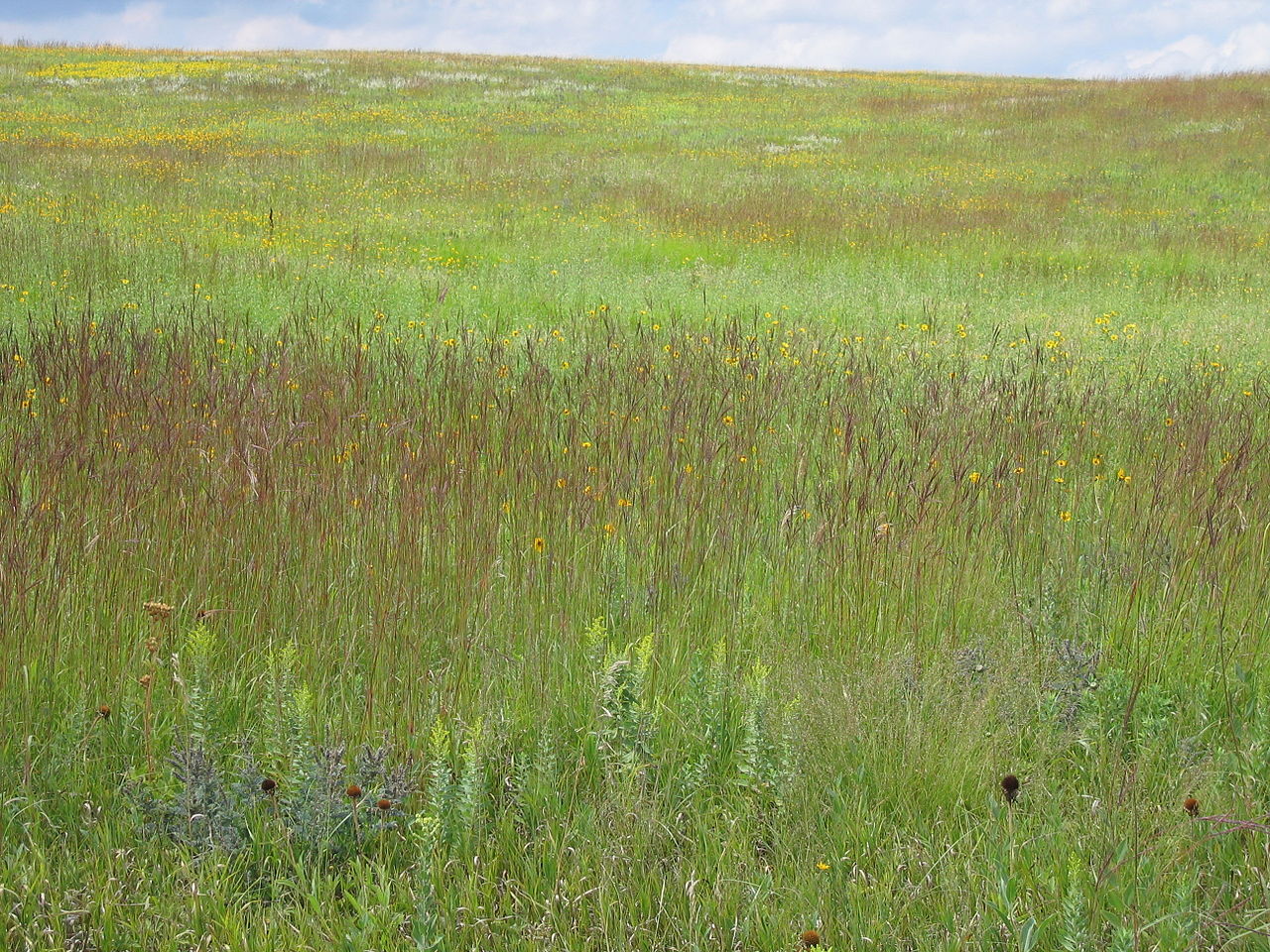
Andropogon gerardii in it's natural habitat: "The purple spikes of big bluestem tower above Maximillian sunflowers and other grasses at Roe Waterfowl Production Area in Codington Co., SD." ©USFWS Mountain-Prairie
.jpg)
MEET THE 'BLACKHAWKS'
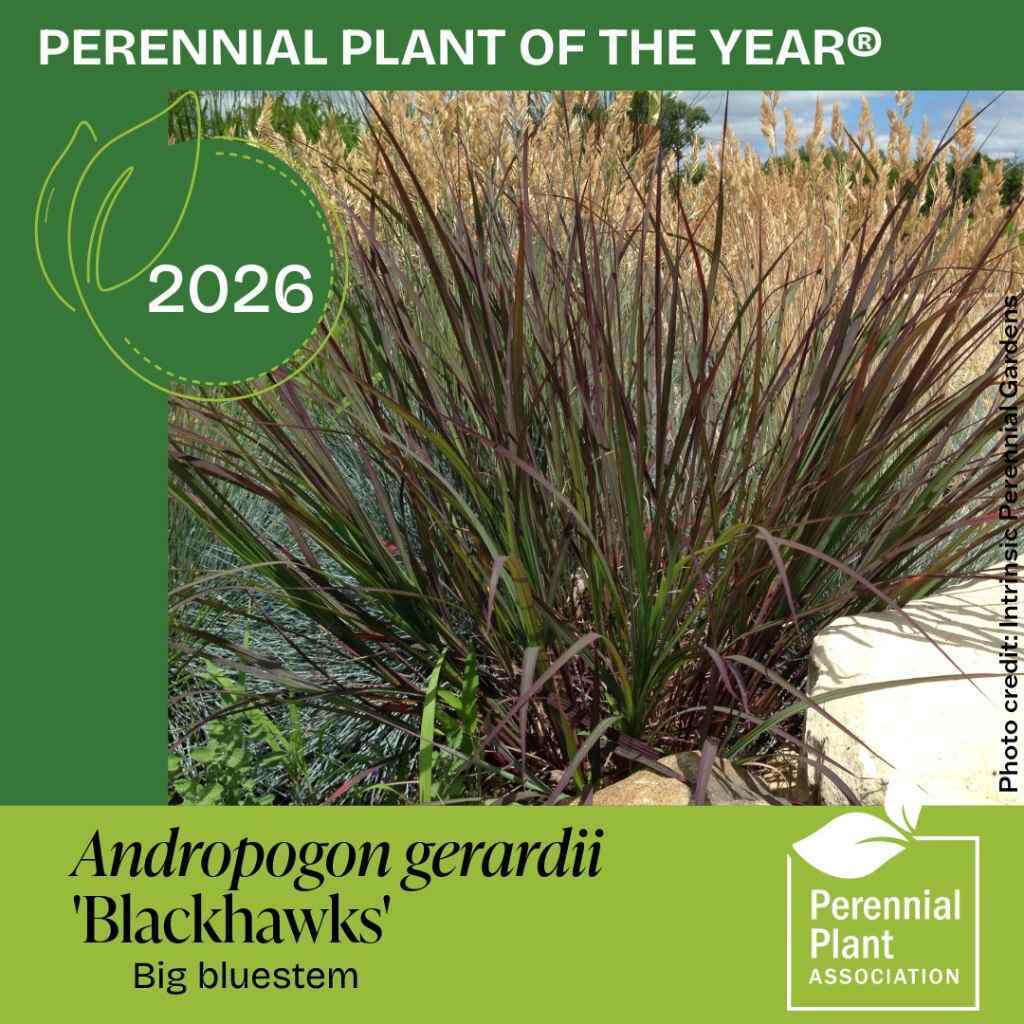
Perennial of the year 2026 is voted for by the members of Perennial Plant Association (PPA) ©PPA/Intrinsic Perennials
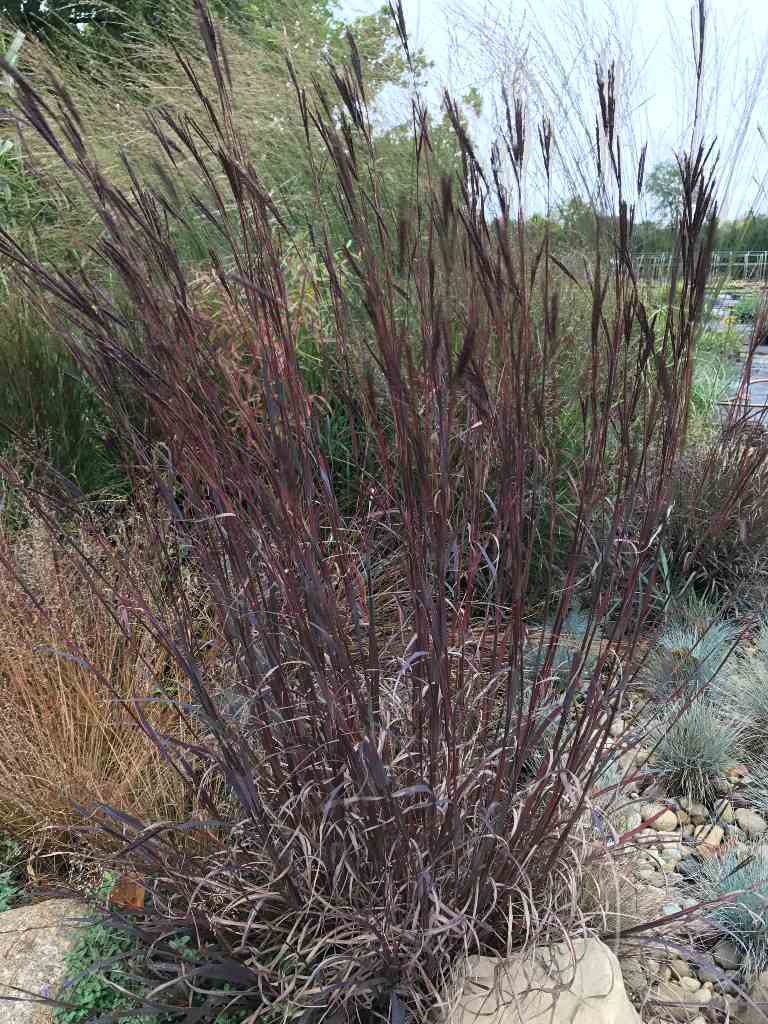
Selected by Brent Horvath from Intrinsic Perennial Gardens (Hebron, Illinois), as a seedling of another of Brent’s selection - Andropogon gerardii 'Red October'. 'Blackhawks' is vegetatively (clonally) propagated and was patented in 2017 under PP27949 (seedlings will be variable). ©Intrinsic Perennial Gardens
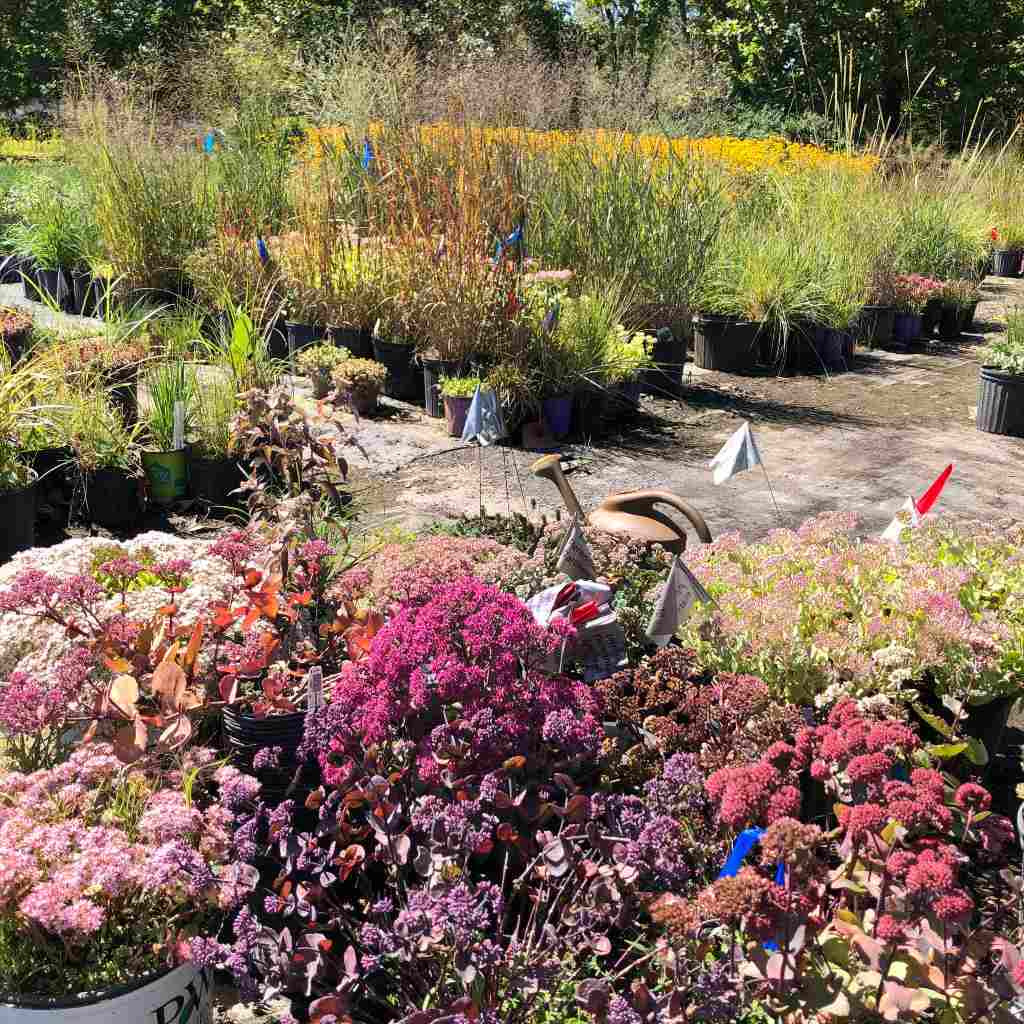
Look at Brent Horvath's alchemy lab at Intrinsic Perennial Gardens. Plants for breeding are brought together for further observation, selection and are exposed to open pollination (the bees do the hard work). The seeds of promise are collected, dried, sown and seedling selected over and over. This is where 'Blackhawks' and many other great Bren't selections were born. ©US Perennials
Still a newbie in 2018, ‘Blackhawks’ received one of the top performing ratings in early grass trials in Chicago Botanic Garden. Check “An Evaluation Study of Hardy Ornamental Grasses.”
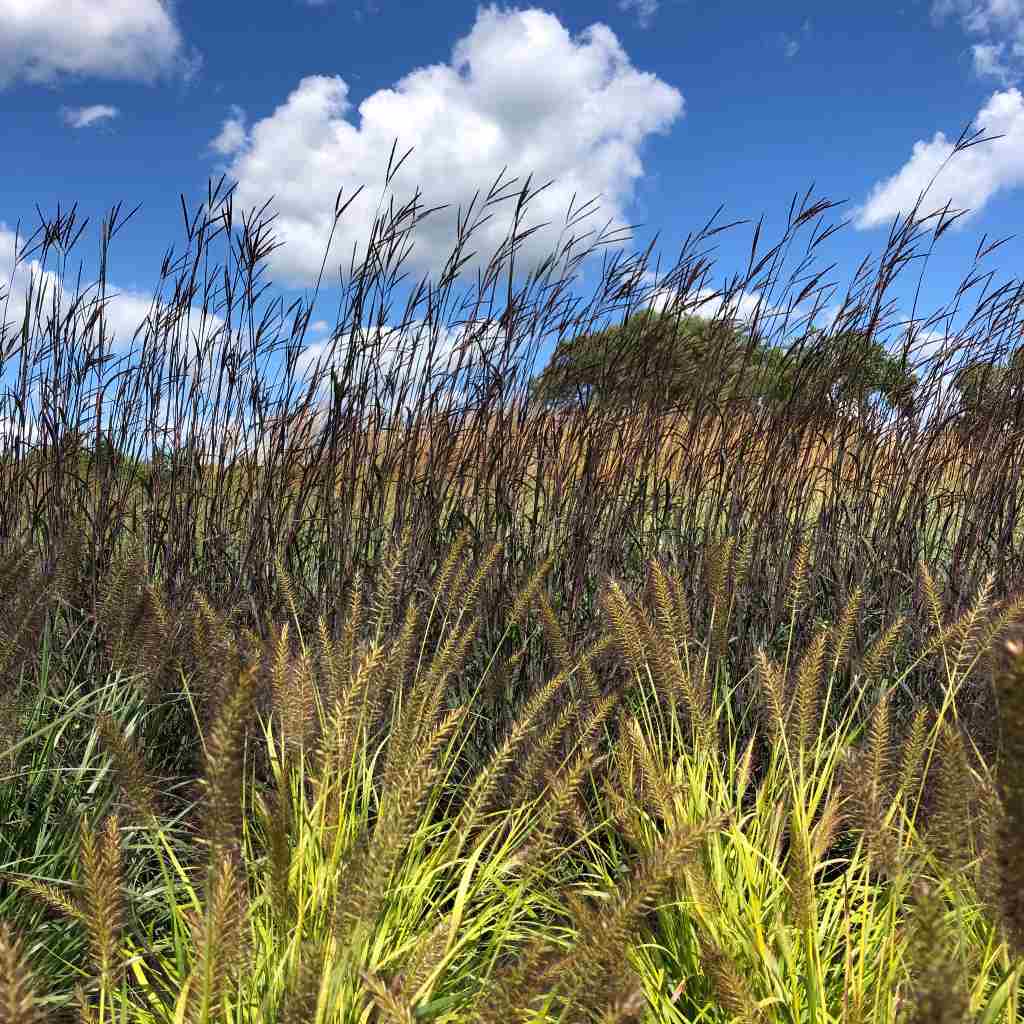
'Blackhawks' with chartreuse Pennisetum alopecuroides 'Pure Energy' at Intrisic Perennial Gardens in Hebron, Illinois. ©US Perennials
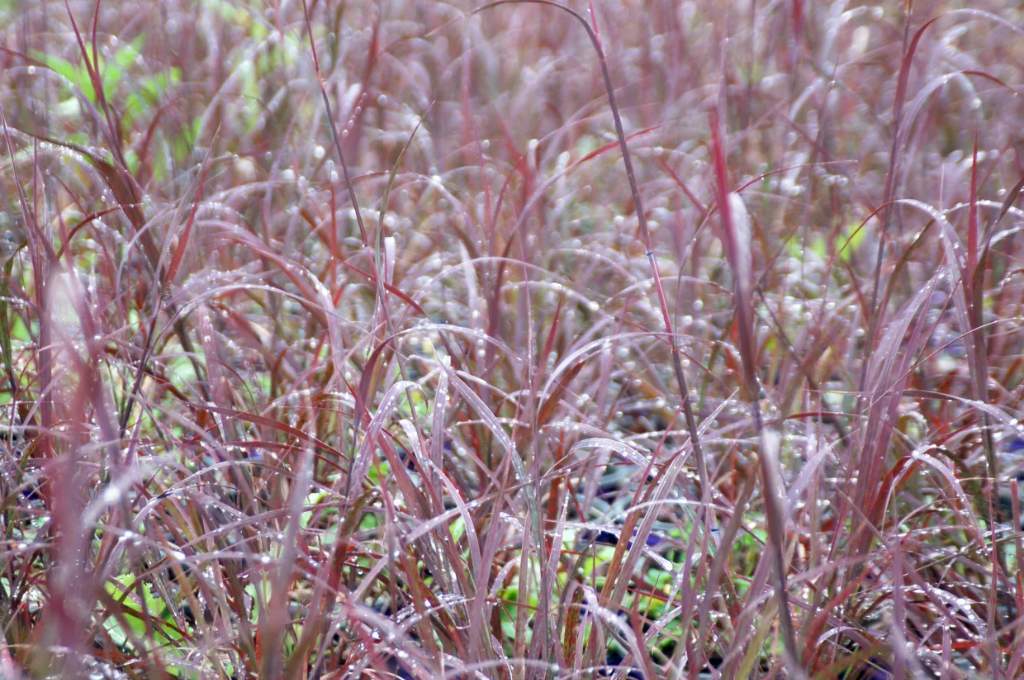
'Blackhawks' in 1 gallon pots at Intrisic Perennial Gardens in Hebron, Illinois. ©Intrinsic Perennial Gardens
'Blackhawks' inherited many of the traits of the species – it is tough, adaptable and long-lived grass. It is a warm season grass, which means the active growth happens during the hot months. You’ll see only small compact clumps of basal leaves - until midsummer hits. Then the prolonging growth booms and big bluestem quickly increases its height and starts to bloom with a typical "turkey’s foot" flower.
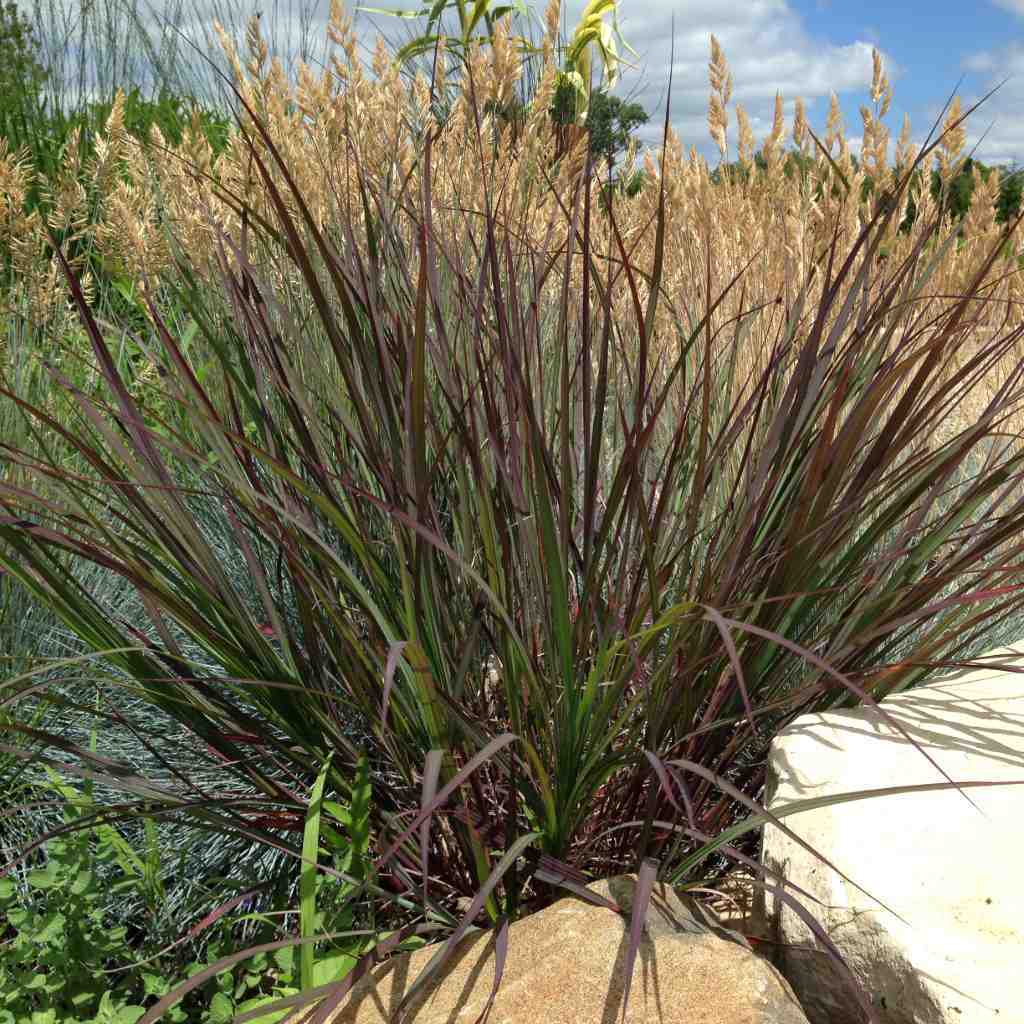
'Blackhawks' foliage emerges dark green, later in summer with more profound reddish-purple leaf tips and joints. In September while fully in bloom, the leaves, stems and blooms take on a deep purple-black hue. It’s also more compact than the species, reaching about 5’ of height and 2’ wide. ©Intrisic Perennial Gardens
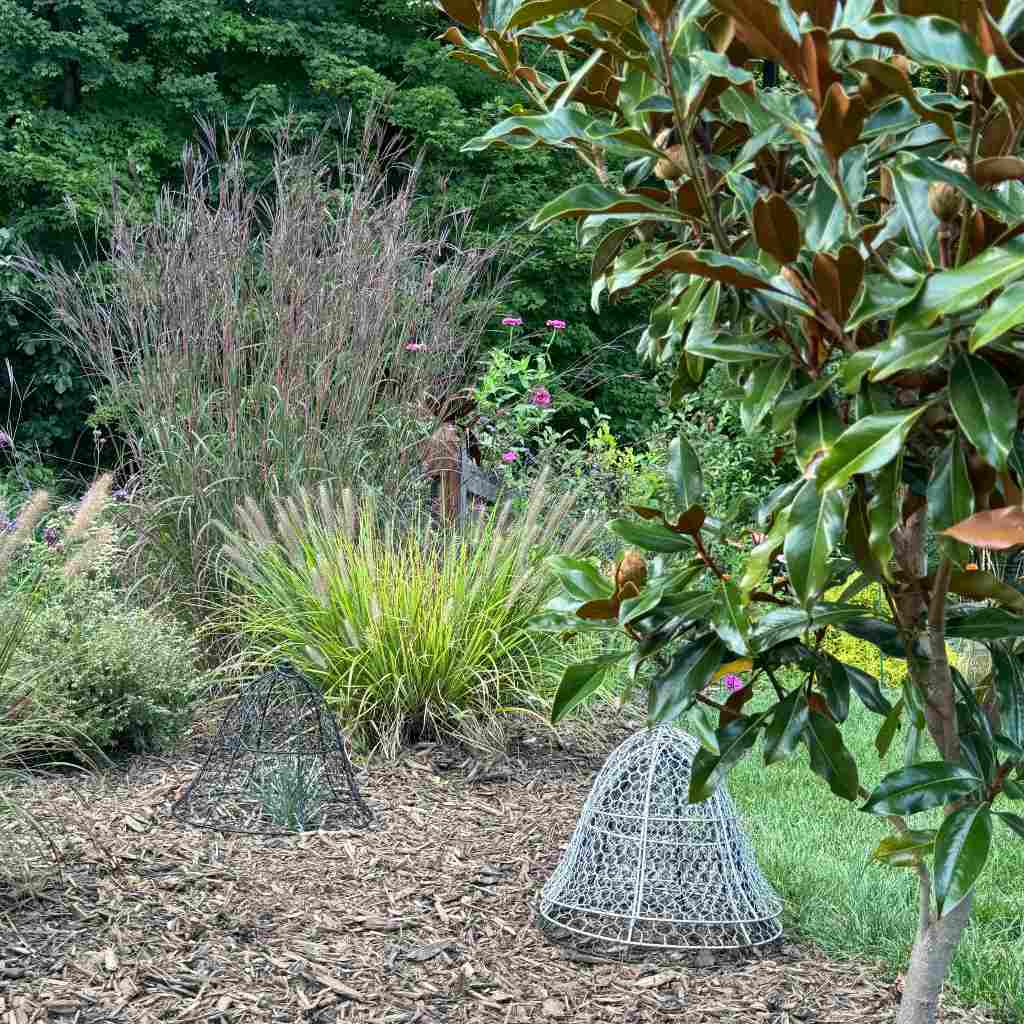
'Blackhawks' in a private garden in the middle of the summer = mid August - it is fully grown and blooming, but doesn't have the deep purple-black color yet. Clay soil enriched with some compost and manure. Bloomington, IN, zone 6a.
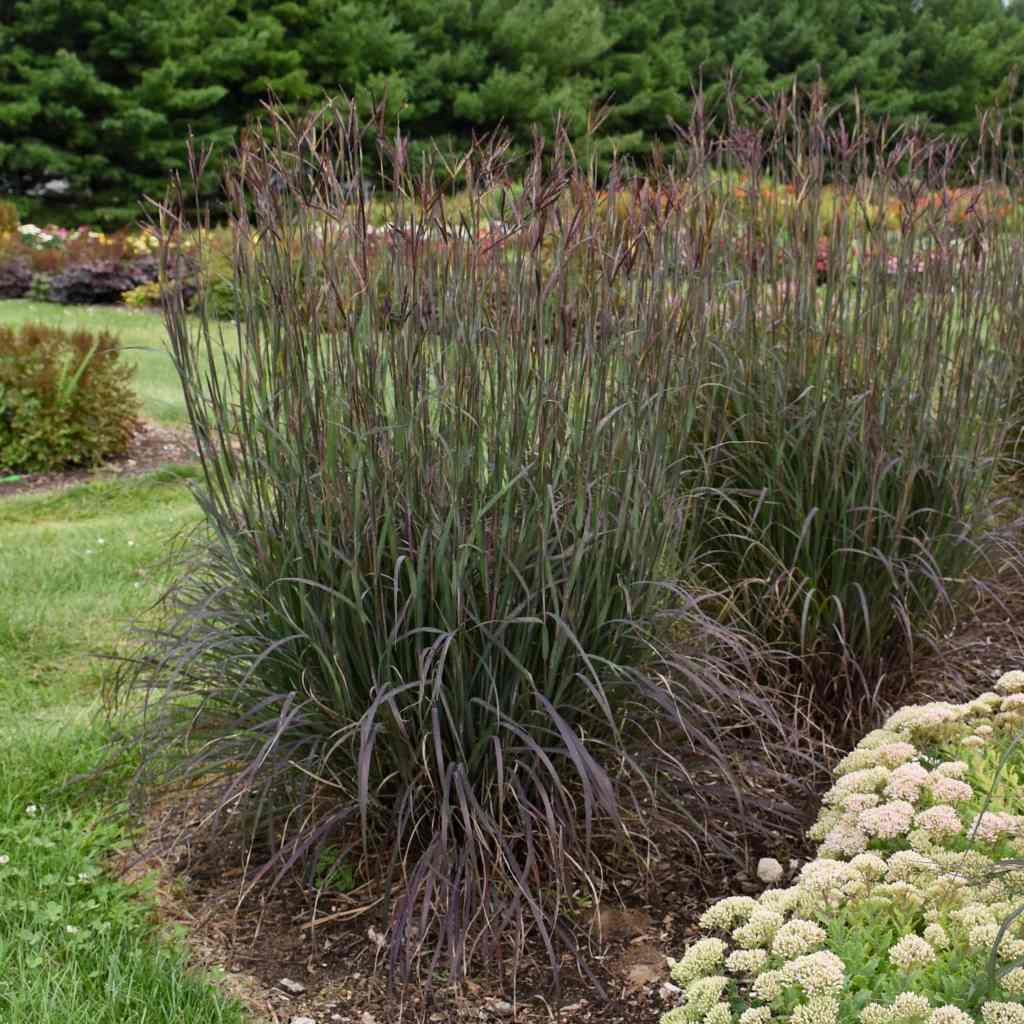
'Blackhawks' in the "Living catalogue gardens in Zeeland, MI at ©Walters Gardens
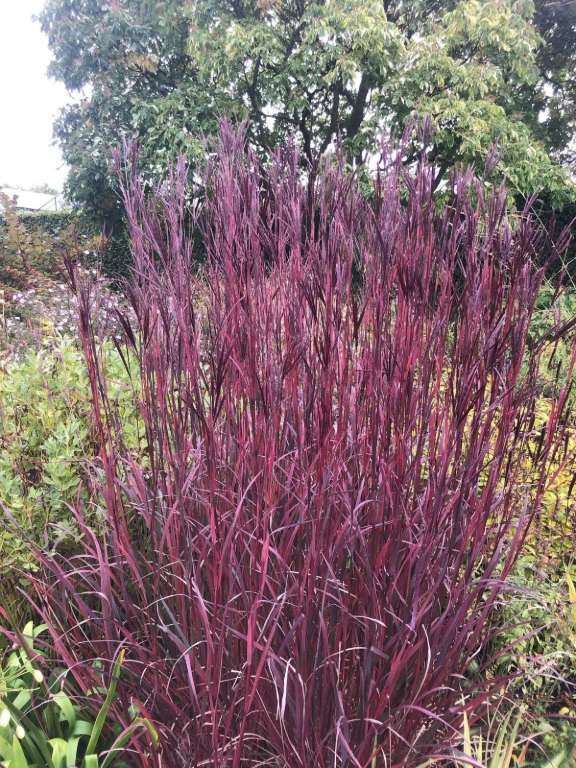
Cooler temps of the early fall help to bring the color out. ©Intrisic Perenial Gardens
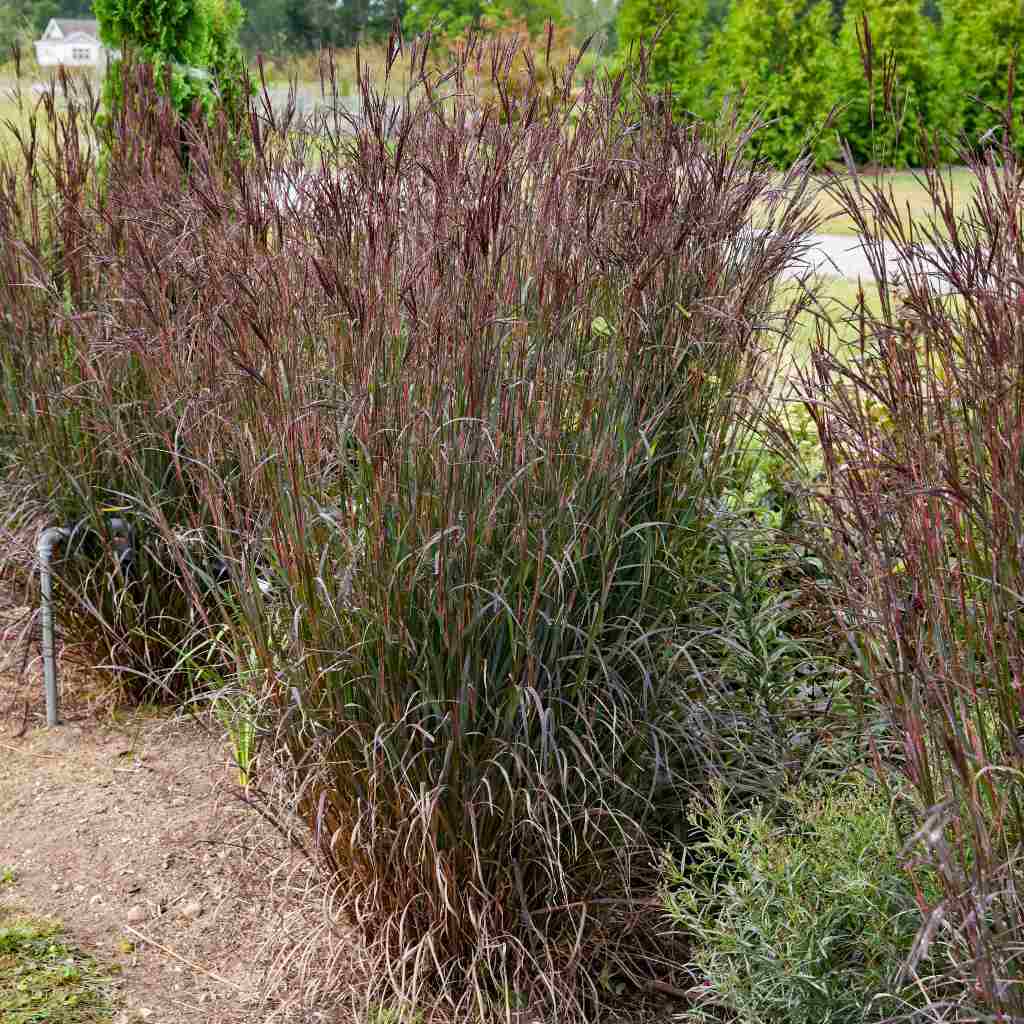
'Blackhawks' is a trouble-free plant and low maintenance grass. No major pest or disease problems (the only maintenance really is to cut it back to the ground in pre-spring. The species of Big Bluestem is a larval host plant for several types of Skippers (Arogos, Delaware, Dusted Skipper). 'Blackhawks' with its darker foliage may be less suitable as a host plant for Skippers (plant colors protect the plant from being eaten). This grass is primarily wind pollinated, the pollen attracts beneficial insects, especially bees and bumblebees (flowers don’t have any nectar). Dense clumps are providing nesting material and shelter for the native bees and the seeds feed small songbirds. ©Walters Gardens
IN THE GARDEN
Full sun location is the best, but it will tolerate little bit of shade during the day. Average soil, clay, loam to sandy soil works well for ‘Blackhawks’. The optimum soil would be average (deeper) garden soil, amended with some organic matter. Too rich of soil + too much moisture can lead to flopping. ‘Blackhawks’ doesn’t usually require additional watering and will live well on the average rainfall (average-medium moisture, seasonally medium-moist, medium-dry).
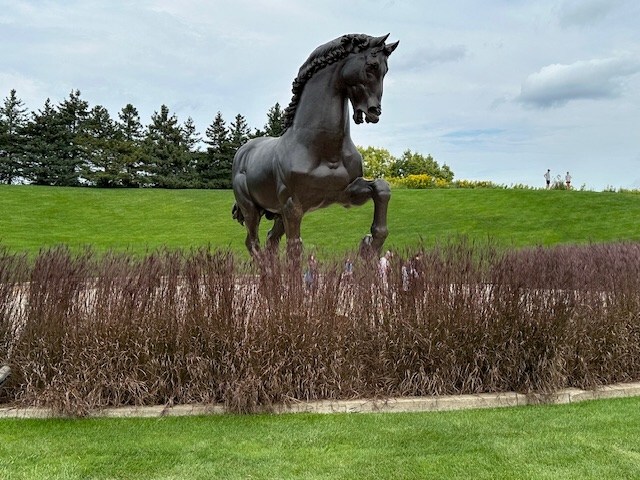
Block planting at Frederik Meijer Gardens & Sculpture Park, Grand Rapids, MI. ©Intrinsic Perennial Gardens
We have trialed 'Blackhawks' in our sand bed, and it did quite well and bulked up significantly even with limited nutrient availability. But with the summer droughts here (the drought gets a lot more pronounced in the sand bed), 'Blackhawks' lost a lot of leaves (the leaves dried out) before they would turn dark. So, it can grow in pure sand, but we recommend 'Blackhawks' for more common growing media = average soil with average moisture.
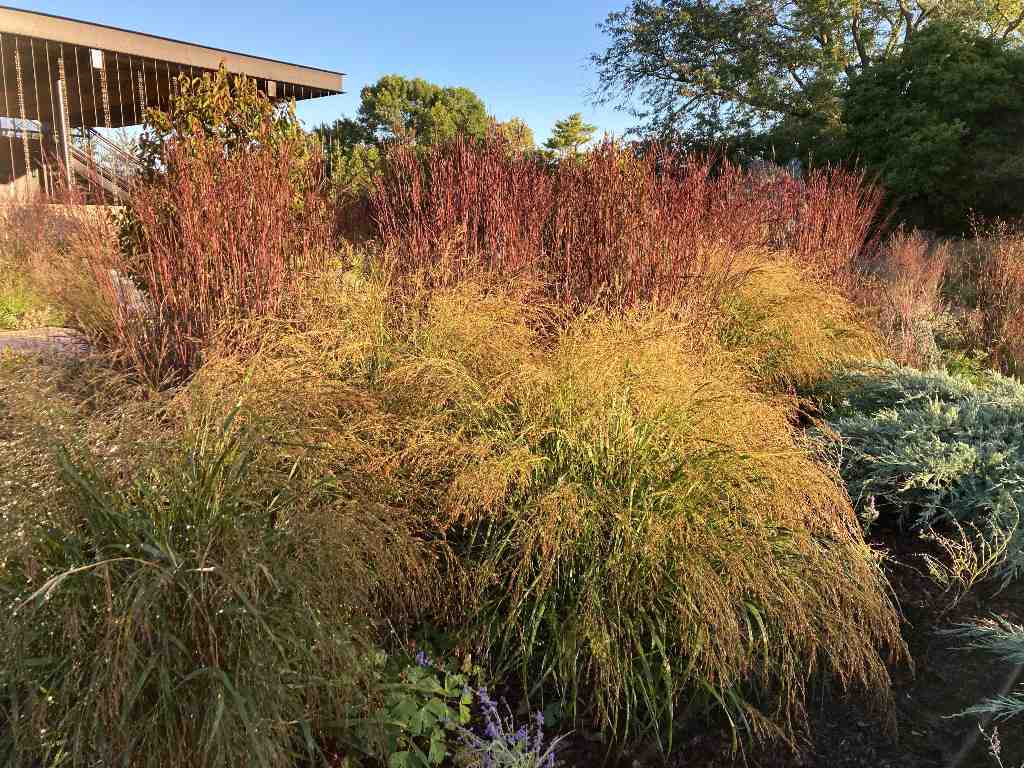
Bigger block planting with Panicum 'Niagara Falls' and Juniperus 'Gray Owl' at © Olbrich Botanical Gardens, Madison, WI
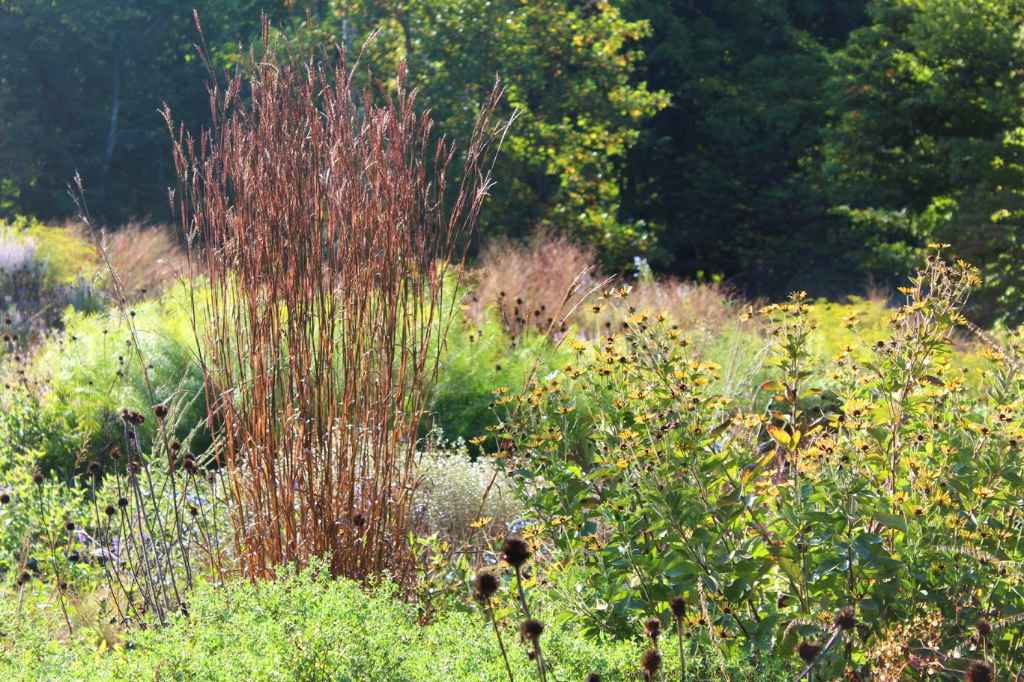
'Blackhawks' in awarded naturalistic garden, designed by Andrew Marrs Garden Design. About mid fall, Bloomington, IN, zone 6a
WHERE IS 'BLACKHAWKS' REALLY "BLACK"
'Blackhawks' will grow anywhere in hardiness zones 3 to 9 (heat zone 4 to 9). We have report of several years of successful cultivation in Dallas area (zone 8b, heat zone 9), but with very little fall coloration.
'Blackhawks' was selected in northern Illinois in zone 5 (Hebron, Il, heat zone 4/5 to 5), where seasonally cooler temps and night temps support richer leaf color.
Here in south central Indiana in Bloomington (hardiness zone 6, heat zone 6/7) we still get a decent coloration. But it is not as rich as in Illinois.
If we look more south (well, southeast from usa) 'Blackhawks' in garden cultivation at Plant Delights Nursery (Raleigh, NC, hardiness zone 8b, heat zone 7) still gets good fall color.
But nearly no fall color in Fort Worth (Dallas area, TX, 8b)
Putting all of this together, we assume that the general rule of “the hotter your area gets, the less color you get” also applies to 'Blackhawks’' Heat zones 4, 5, 6 may be the best ones, while zone 7 may be the limiting for the full coloration (heat zone maps somewhat correlate to hardiness zone).
You can check your heat zone area here.
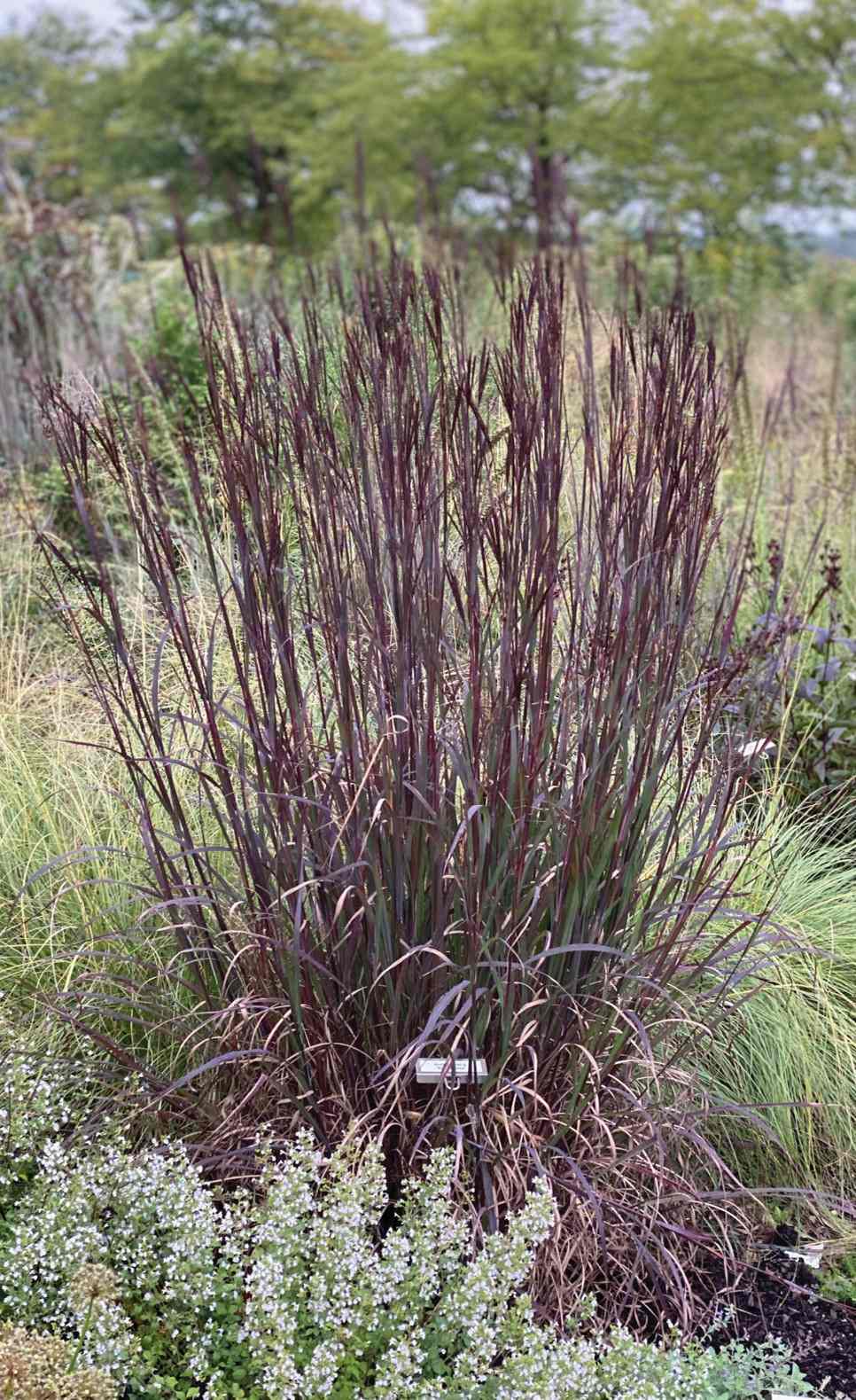
Big Bluestem 'Blackhawks' with white Calamintha nepeta ssp. nepeta at ©Midwest Groundcovers, Illinois (near Chicago)
GOOD COMPANIONS
For it’s adaptability can be combined with many common perennials, shrubs and other grasses in sunny flower beds, prairie-inspired gardens, naturalistic gardens, bigger block or matrix plantings.
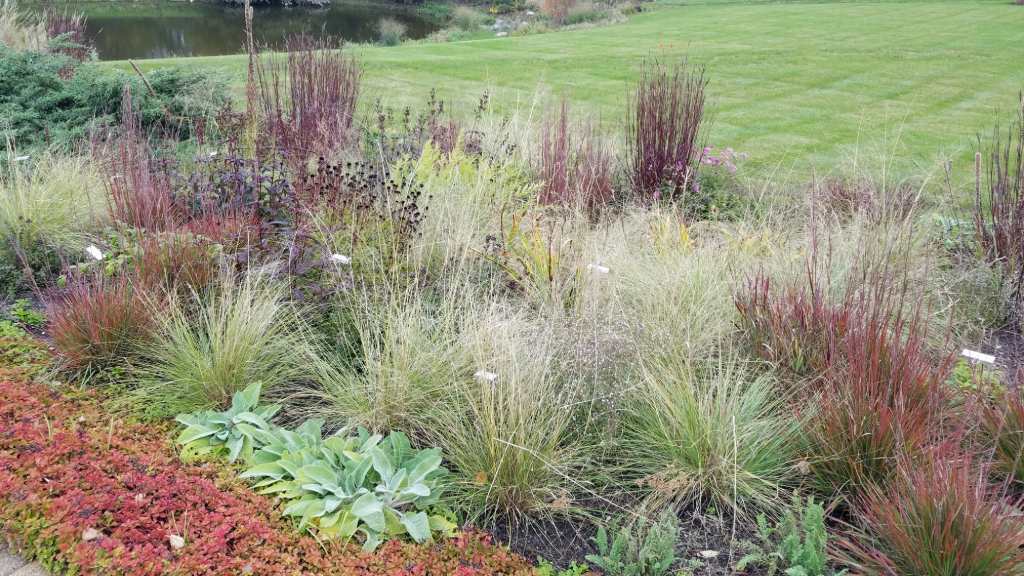
Matrix planting ©Midwest Groundcovers
Good companions that can make good combos (due its later presence in the garden are) :
Aconitum, summer blooming Alliums, fall color of Amsonia, Anemone hupehensis hybrids, Asters, Echinacea, Eryngium yuccifolium, Euphorbia corollata, all season blooming hardy geraniums (G. 'Rozanne' family), Heliopsis, Helianthus (perennial sunflower), Helenium, later blooming Hemerocallis, Hibiscus moscheutos hybrids, later blooming Liatris (L. aspera, L. ligulistylis, L pycnostacya, l. scariosa), Monarda punctata, Parthenium integrifolium, Perovskia, tall Phloxes, Pycnanthemum, Rudbeckia (R. fulgida, and especially R. subtomentosa, R. maxima), Sanguisorba, Silphium (for it’s bold contrasting structures), Stachys, Verbena bonariensis, Vernonia, Good grass companions are those with fresh green (Pennisetum cultivars), chartreuse (Sesleria) or silver colors (Panicum, Schizachyrium), or late blooming Muhlenbergia or Sporobolus.
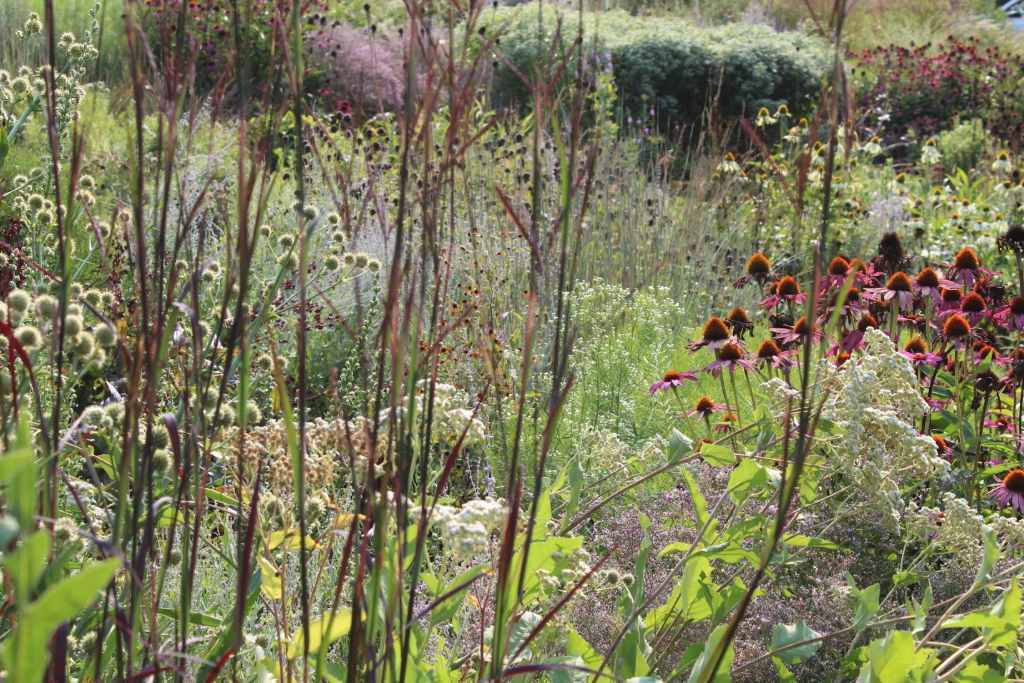
A view through the clump of Andropogon 'Blackhawks' in naturalistic perennial garden designed by Andrew Marrs Garden Design. Mid to late summer, Bloomington, IN. ©Andrew Marrs Garden Design
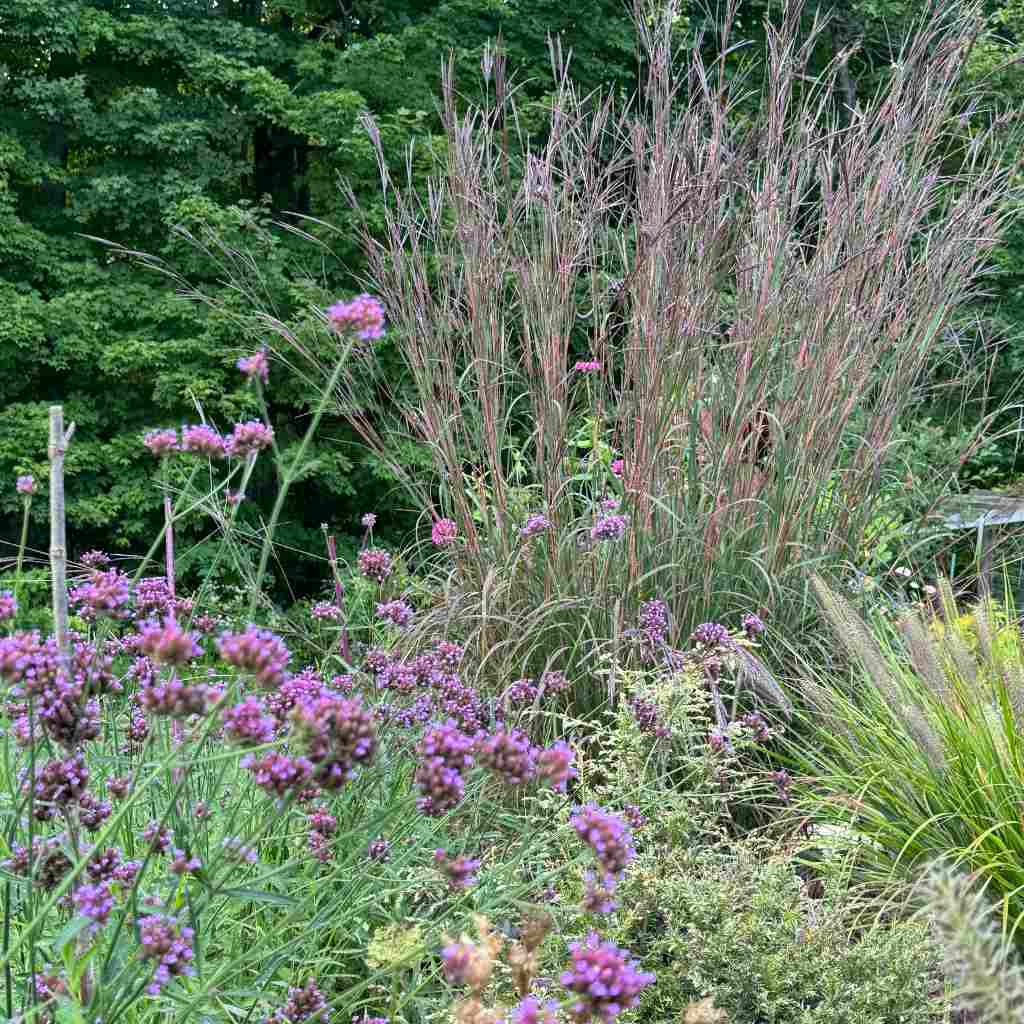
Looks awesome with Hydrangea paniculata! Other suitable shrubs could be Callicarpa, Caryopteris, Diervilla, Itea, Juniperus, medium to smaller sized Hibiscus syriacus; and others....Good combos are with taller annuals like Cosmos, Tithonia, Zinnia, tender Salvia, or Verbena bonariensis. Pic taken in mid August, Bloomington, IN. ©US Perennials
"THE LESS BLACK BLACKHAWKS"
The species of Andropogon gerardii has very large range of natural appearance (with it’s own variability). Even the wild form is a great structural plant for garden use, and often has some fall color too. Since the North American plants are in the focus of the plant breeders for a while, we have more options to choose from. Both for the garden use and for restoration or regionally more suitable selections:
'Red October' - green foliage with deep red fall color after frost
'Holy Smoke' - green and red foliage matures to a smoky purple-pink, with purple-black flowers
'Dancing Wind' - upright, green stems with strong red highlights, that in the fall turn to scarlet
'Rain Dance' - tall and upright, dark green foliage and burgundy highlights from late summer
Windwalker® (with technical cultivar name 'PWINO1S')- distinctive gray-blue foliage and rich purple-red fall color, selected for drier conditions of central USA
'Lord Snowden' - tall, slender with powdery blue-gray color, probably the best for dry or sandy soil. Selected from Andropogon gerardii ssp. hallii (A. hallii) - Sand Bluestem, which is hairy and often more silver-gray, and is well adapted to sandy soils. Native to central USA from Texas up to Canada
Karl's Cousin® (the cultivar name is very technical 'Nondhwr') - shorter (4.5'), strictly upright and very narrow, green-blue foliage turns to rich purple-blue with late season. Part of Hortech's Prairie Proud® serie
'Rainbow Pillar'® - upright and colorful, with changing caleidoscope of colors - from spring blue-purple, to aber-coral with indigo-purple. Part of Hortech's Prairie Proud® serie
'Peach Blush'™ - tall, loose columnar selection, gray-green foliage, bricha peach flowers and pastel segments of muted indigo and glaucous purple. Part of Hortech's Prairie Proud® serie
Hazy Blue™ - blue green foliage turning, dusky flower culms in dark shades of navy, maroon, and glaucous purple. Part of Hortech's Prairie Proud® serie
'Indian Warrior' - dusky red-purple tones mature to deep purple
'Lady Bug Red' - selection of western provenience, suitable for drier central states, only 48" with bright red fall colors
Older cultivars like 'Bull's Eye', 'Mega Blue' and 'Red Blue' were trialed in Chicago Botanic Garden in 2013, but disappeared or disolved into newer selections.
For restoration projects :
'Bison' – regional seed selection from North Dakota, highly drought-tolerant and hardy.
'Bonilla' - regional seed selection from South Dakota, with great winter hardiness.
'Champ' – regional seed selection from Nebraska and Iowa, widely used for forage and reclamation.
'Kaw' - regional seed selection from Kasnas, standard, high-production cultivar.
'Pawnee' - regional seed selection from Nebraska, valued for the ability to produce high biomass.
'Rountree' - regional seed selection from Iowa, selected for its vigor.
'Earl' - regional seed selection from Texas, adapted for southern regions.
'Niagara' - regional seed selection from New York, suitable for the Eastern US.
Blackhawks logo picture : Design and copyright Preston Montague / PPA