Sold out


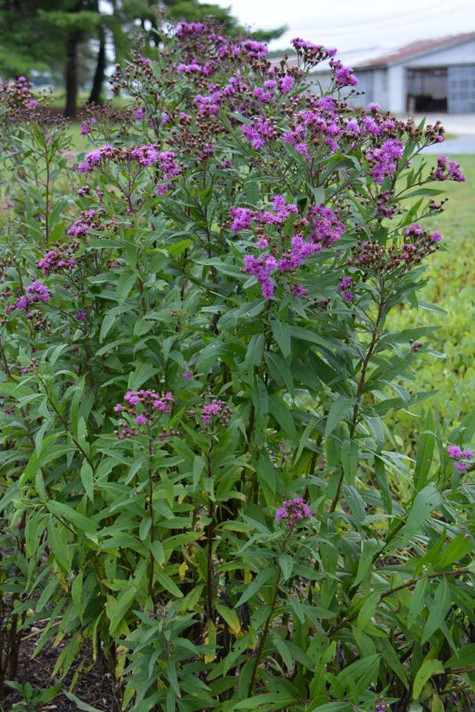
Taller upright Ironweed, with late summer-early fall blooms.
Reminds of another common New York Ironweed (V. noveboracensis), but the leaves are wider and it can tolerate drier conditions!
Blooming Time: July/August to August/September
Size: usually close to 5' tall x 2-4' wide clumps.
USDA zones: 6 to 8/9
Culture: full sun, half shade. Average soil with average moisture, adaptable to various soils. Established plants are drought tolerant.
Moisture Needs: medium to medium-dry and medium-moist. Tolerant to heat, humidity
Origin: southeastern and eastern USA (AL, DC, DE, GA, MD, MS, NC, NJ, PA, SC, TN, VA, WV),see the BONAP distribution map.
Deer/rabbit resistant: yes/yes
Attracts Butterflies or Pollinators: native bees, butterflies
Attracts Hummingbirds: yes
Pot size: square 3.5 " x 4" deep perennial pot
Plant combinations: For cottage gardens, pollinator gardens, hummingbird gardens, slopes, naturalization in the woodland edge gardens. Good companions can be many medium-sized or bigger common perennials. In sunny location it can be Amsonia, Asters, Baptisia, taller hardy Geraniums, Irises, larger Nepeta, Paeonia, Rudbeckia, larger Salvia, tall Sedum, grasses like Calamagrostis or Panicum.
In half-shade, dappled sun/shade woodland edge/ woodland perennials - Aquilegia, Anemone x hupehensis, Chelone, Chrysogonum, Dicentra, Gillenia, Geum, Helleborus, Heuchera, Hosta, Polemonium, Polygonatum, Polygonum, Tradescantia, Tricyrtis, Spigellia, or sedges - Carex or Hakonechloa.
Or combine with medium-sized shrubs.
Picture copyright: New Moon Nursery
Taller upright Ironweed, with late summer-early fall blooms.
Reminds of another common New York Ironweed (V. noveboracensis), but the leaves are wider and it can tolerate drier conditions!
Blooming Time: July/August to August/September
Size: usually close to 5' tall x 2-4' wide clumps.
USDA zones: 6 to 8/9
Culture: full sun, half shade. Average soil with average moisture, adaptable to various soils. Established plants are drought tolerant.
Moisture Needs: medium to medium-dry and medium-moist. Tolerant to heat, humidity
Origin: southeastern and eastern USA (AL, DC, DE, GA, MD, MS, NC, NJ, PA, SC, TN, VA, WV),see the BONAP distribution map.
Deer/rabbit resistant: yes/yes
Attracts Butterflies or Pollinators: native bees, butterflies
Attracts Hummingbirds: yes
Pot size: square 3.5 " x 4" deep perennial pot
Plant combinations: For cottage gardens, pollinator gardens, hummingbird gardens, slopes, naturalization in the woodland edge gardens. Good companions can be many medium-sized or bigger common perennials. In sunny location it can be Amsonia, Asters, Baptisia, taller hardy Geraniums, Irises, larger Nepeta, Paeonia, Rudbeckia, larger Salvia, tall Sedum, grasses like Calamagrostis or Panicum.
In half-shade, dappled sun/shade woodland edge/ woodland perennials - Aquilegia, Anemone x hupehensis, Chelone, Chrysogonum, Dicentra, Gillenia, Geum, Helleborus, Heuchera, Hosta, Polemonium, Polygonatum, Polygonum, Tradescantia, Tricyrtis, Spigellia, or sedges - Carex or Hakonechloa.
Or combine with medium-sized shrubs.
Picture copyright: New Moon Nursery