

Sold out


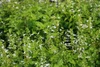
Cultivar of native sage, with delicate PURE WHITE flowers.
Very long flowering for a very long season. Often grown as annuals in cooler areas (and persists by self-seeding)
Drought, heat and humidity tolerant and pollinator magnet!
Also called "Texas Sage" or "Hummingbird Sage" (natural hummingbird feeder).
Blooming time: early summer frost (late fall)
Size: size depends if grown as annual or perennial crop. Where annual = 14-16" tall and wide, where perennial 24” tall x 20-24" wide
USDA Zones: 8 to 10
Culture: full sun to half shade, dappled sun - ideal is 6+ hours of direct sun or more. Adaptable and easy - any soil, any pH with some organic matter, moderately fertile and somewhat drained. Tolerant to heat and humidity, established plants tolerate droughts and temporary drier conditions
Moisture Needs: average - medium to medium-dry
Origin: Garden origin selection, the species of Salvia coccinea is native to southern and some southeastern states, but also Missouri and Ohio (which suggests that this plant was most likely lot more spread before the glaciation). See the BONAP distribution map.
Black Walnut Tolerant: yes
Deer/Rabbit Resistant: yes / yes - the whole plant is aromatic
Attracts Butterflies or Pollinators: this is a true pollinator magnet = yes/yes - various bees, butterflies and beetles
Attracts Hummingbirds: yes
Pot Size: square 3.5" x 4" deep perennial pot
Plant Combinations: For sunny garden (public and private), moon gardens, white gardens. Can be combined with plants that prefer somewhat drier conditions (and are drought tolerant). For natives choose shorter Agastache, shorter Amsonia, Antennaria, Asclepias tuberosa, smaller Baptisia, Campanula rotundifolia, Coreopsis, Cunila origanoides, Dalea, Eryngium juccifolium, Echinacea, Gaillardia, Gaura (shorter cultivars), shorter Liatris, Penstemons, Ruellia humilis, Stokesia, Verbena canadensis, Yucca, native grasses like Boutelloa gracilis or B. curtipendula, Muhlenbergia, Sporobolus heterolepis (or non-native Sesleria), Panicum.
And with non-native perennials like Achillea, summer blooming Allium, shorter Aquilegia, Armeria, shorter Aster, Calamintha, Campanula, Cerastium, Delosperma, Dianthus, Eryngium, Geranium (G. sanquineum, G. dalmaticum and x cantabrigiense, G. endresii, G. renardii), Gypsohila, Iris x barbata (=I. x germanica), Lavandula, Nepeta, Origanum, Paeonia, Perovskia, Platycodon, Satureja, other Salvia, Sedum, Sempervivum, low Stachys, Scabiosa columbaria, Thymus, lower Veronica, etc.
But it will also go well with plants that like more moisture = Iris sibirica, Leucanthemum x superbum, Hemerocallis (daylily), Hibiscus, Monarda, Phlox paniculata hybrids or Phlox carolina hybrids.
Pictures Copyright: David J. Stang, Commons Wikimedia
Cultivar of native sage, with delicate PURE WHITE flowers.
Very long flowering for a very long season. Often grown as annuals in cooler areas (and persists by self-seeding)
Drought, heat and humidity tolerant and pollinator magnet!
Also called "Texas Sage" or "Hummingbird Sage" (natural hummingbird feeder).
Blooming time: early summer frost (late fall)
Size: size depends if grown as annual or perennial crop. Where annual = 14-16" tall and wide, where perennial 24” tall x 20-24" wide
USDA Zones: 8 to 10
Culture: full sun to half shade, dappled sun - ideal is 6+ hours of direct sun or more. Adaptable and easy - any soil, any pH with some organic matter, moderately fertile and somewhat drained. Tolerant to heat and humidity, established plants tolerate droughts and temporary drier conditions
Moisture Needs: average - medium to medium-dry
Origin: Garden origin selection, the species of Salvia coccinea is native to southern and some southeastern states, but also Missouri and Ohio (which suggests that this plant was most likely lot more spread before the glaciation). See the BONAP distribution map.
Black Walnut Tolerant: yes
Deer/Rabbit Resistant: yes / yes - the whole plant is aromatic
Attracts Butterflies or Pollinators: this is a true pollinator magnet = yes/yes - various bees, butterflies and beetles
Attracts Hummingbirds: yes
Pot Size: square 3.5" x 4" deep perennial pot
Plant Combinations: For sunny garden (public and private), moon gardens, white gardens. Can be combined with plants that prefer somewhat drier conditions (and are drought tolerant). For natives choose shorter Agastache, shorter Amsonia, Antennaria, Asclepias tuberosa, smaller Baptisia, Campanula rotundifolia, Coreopsis, Cunila origanoides, Dalea, Eryngium juccifolium, Echinacea, Gaillardia, Gaura (shorter cultivars), shorter Liatris, Penstemons, Ruellia humilis, Stokesia, Verbena canadensis, Yucca, native grasses like Boutelloa gracilis or B. curtipendula, Muhlenbergia, Sporobolus heterolepis (or non-native Sesleria), Panicum.
And with non-native perennials like Achillea, summer blooming Allium, shorter Aquilegia, Armeria, shorter Aster, Calamintha, Campanula, Cerastium, Delosperma, Dianthus, Eryngium, Geranium (G. sanquineum, G. dalmaticum and x cantabrigiense, G. endresii, G. renardii), Gypsohila, Iris x barbata (=I. x germanica), Lavandula, Nepeta, Origanum, Paeonia, Perovskia, Platycodon, Satureja, other Salvia, Sedum, Sempervivum, low Stachys, Scabiosa columbaria, Thymus, lower Veronica, etc.
But it will also go well with plants that like more moisture = Iris sibirica, Leucanthemum x superbum, Hemerocallis (daylily), Hibiscus, Monarda, Phlox paniculata hybrids or Phlox carolina hybrids.
Pictures Copyright: David J. Stang, Commons Wikimedia


