Sold out


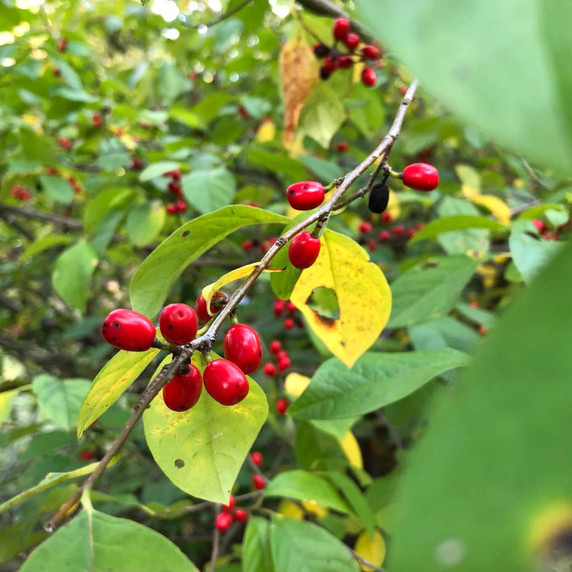
A common shrub in the moist woods of eastern North America, Lindera benzoin is one of the first native shrubs to bloom. It becomes conspicuous early in the spring blooming period, when clusters of small yellowish flowers appear on its bare branches. Spicebush blends into the forest through the summer, until the end of early fall when its fruits are ripe; they are shiny, red, and usually supported by the first yellow leaves.
The entire plant has an interesting, spicy/lemony fragrance, and the fresh leaves can be used in hot or iced tea (they don’t retain their flavor well when dried). The twigs can be simmered in water for a warming tea any time of year. The dried red berries can be used as a spice that has both sweet and savory uses - the Ojibwa and Iroquois tribes treated spicebush berries as two different seasonings – the separated pulp and red skin have a sweet, allspice-like taste, and the seeds offer a peppery bite.
This adaptable and useful shrub is shorter and more compact in full sun, and has a wider, more open structure in full shade. Spicebush is the host plant for the larval stage of the spicebush swallowtail butterfly (cocoons are wrapped within rolled leaves). Both male and female plants are required to produce berries on female plants; since our plants are seed-grown, we do not know if they will be male or female.
Can be planted in woodland gardens, shady spots, woodland edges, pollinator gardens, herb gardens, along streams, or naturalized. The genus name honors Johann Linder (1676-1723), a Swedish botanist and physician.
Picture copyright : US Perennials nursery
Blooming Time: March
Size: usually 8’ tall x 5’ wide (up to 12’ tall in full deep shade, also more wide and loose)
USDA Zones: 4 to 9
Culture: prefers dappled sunshine or half-shade, but it is very adaptable to garden soils and will grow in full sun or full shade. Average soils, good garden soil, loam, or organic soil, prefers somewhat drained soils (can grow right along streams, if the soils is gravely).
Moisture Needs: medium, moist
Origin: Eastern United States (see the USDA distribution map), grows naturally in rich deciduous woodlands, wooded bluffs, bottomland forests, on wooded slopes, and along rivers
Deer/Rabbit Resistant: yes / yes
Attracts Butterflies or Pollinators: yes – it is pollinated by small native bees and flies. It is also a host plant for 3 butterflies - Spicebush Swallowtail, Promethea Moth and Tulip Tree Beauty. The berries are eaten by some upland gamebirds and several woodland songbirds.
Attracts Hummingbirds: no
Pot Size: square 3.5'' x 4'' deep pot
A common shrub in the moist woods of eastern North America, Lindera benzoin is one of the first native shrubs to bloom. It becomes conspicuous early in the spring blooming period, when clusters of small yellowish flowers appear on its bare branches. Spicebush blends into the forest through the summer, until the end of early fall when its fruits are ripe; they are shiny, red, and usually supported by the first yellow leaves.
The entire plant has an interesting, spicy/lemony fragrance, and the fresh leaves can be used in hot or iced tea (they don’t retain their flavor well when dried). The twigs can be simmered in water for a warming tea any time of year. The dried red berries can be used as a spice that has both sweet and savory uses - the Ojibwa and Iroquois tribes treated spicebush berries as two different seasonings – the separated pulp and red skin have a sweet, allspice-like taste, and the seeds offer a peppery bite.
This adaptable and useful shrub is shorter and more compact in full sun, and has a wider, more open structure in full shade. Spicebush is the host plant for the larval stage of the spicebush swallowtail butterfly (cocoons are wrapped within rolled leaves). Both male and female plants are required to produce berries on female plants; since our plants are seed-grown, we do not know if they will be male or female.
Can be planted in woodland gardens, shady spots, woodland edges, pollinator gardens, herb gardens, along streams, or naturalized. The genus name honors Johann Linder (1676-1723), a Swedish botanist and physician.
Picture copyright : US Perennials nursery
Blooming Time: March
Size: usually 8’ tall x 5’ wide (up to 12’ tall in full deep shade, also more wide and loose)
USDA Zones: 4 to 9
Culture: prefers dappled sunshine or half-shade, but it is very adaptable to garden soils and will grow in full sun or full shade. Average soils, good garden soil, loam, or organic soil, prefers somewhat drained soils (can grow right along streams, if the soils is gravely).
Moisture Needs: medium, moist
Origin: Eastern United States (see the USDA distribution map), grows naturally in rich deciduous woodlands, wooded bluffs, bottomland forests, on wooded slopes, and along rivers
Deer/Rabbit Resistant: yes / yes
Attracts Butterflies or Pollinators: yes – it is pollinated by small native bees and flies. It is also a host plant for 3 butterflies - Spicebush Swallowtail, Promethea Moth and Tulip Tree Beauty. The berries are eaten by some upland gamebirds and several woodland songbirds.
Attracts Hummingbirds: no
Pot Size: square 3.5'' x 4'' deep pot
Great looking plants! Will order from nursery again